


There are two ways to survive a metal cycle. One is by mastering capital. The other is by mastering yourself.
Godawari taught the first. When prices cheered, it held its nerve. When debt pulled tight, it chose repair over applause. That story was a lesson in how money moves, how capacity arrives late, and how discipline outlasts fashion.

Sarda taught the second. It was not only furnaces and mines. It was a promoter who trusted stillness over noise. Intuition over impulse. The charioteer within guiding the horses. That story was a lesson in how decisions feel before they show up in numbers.
Sarda Energy & Minerals Ltd

They say life is a chariot. The body is the carriage. The mind is the rider. And the five horses are the senses, restless, hungry & impatient.
Put the two together and you get a simple truth. Cycles test balance sheets. Cycles also test people. The best outcomes occur when both pass the test simultaneously.
That is why our third company in this sector belongs here. It is the third path in the same landscape. Not just capital discipline. Not only the promoter will. Something slower. Endurance.
Think of it this way. Godawari showed how to turn cash into control. Sarda showed how to turn stillness into foresight. Jayaswal Neco shows how to come back when both have been stretched, when the story seems over, and then find a cleaner rhythm.
To understand why, we need to look back. How the company began with pipes and castings in the heart of India. How it climbed into steel. The debt. It stumbled. It fought through courts and creditors. Then it rebuilt its footing one careful step at a time.
Now here is the catch. Recoveries rarely announce themselves. They show up as small signals. A mine that covers all the ore you need. A furnace that runs longer without drama. An interest meter that finally slows. In Jayaswal Neco, those signals began to line up.
So this is the frame for what follows.
Godawari was about capital as a compass.
Sarda was about conscience as a compass.
Jayaswal Neco is about stamina as a compass.
The same cycle. A different lesson. And a story worth reading. So let’s begin!
Jayaswal Neco Industries Ltd began its story in Nagpur in the early 1970s. At the centre of it was a young entrepreneur named Basant Lall Shaw. In 1972, he left Kolkata during a time of social unrest and came to Nagpur, determined to build something from the ground level.
What he started was small, but it carried a sense of purpose. He set up a modest iron foundry called Nagpur Engineering Company. Its early products were simple, mostly cast-iron pipes and fittings for municipal corporations and Indian Railways.

Source: Company Website
Nagpur, sitting almost at the country’s center, gave him an edge. From there, he could reach every corner of India. Slowly, through persistence and long hours, he built a network that carried his pipes and castings across the nation. It was not a business built overnight. It was built through consistency.
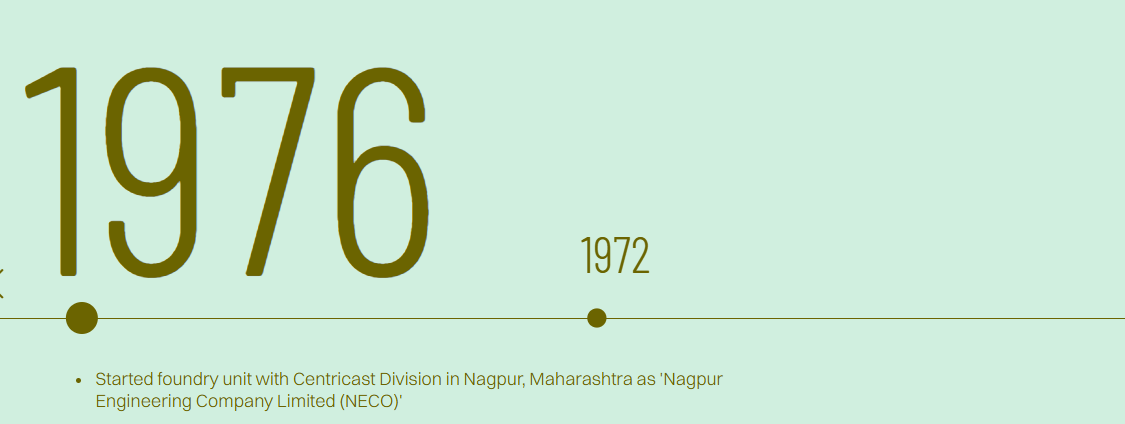
By 1976, the effort had begun to take shape. The company set up its first foundry unit called the Centricast Division. The company grew its presence in the foundry business, making cast iron pipes, manhole covers, and engineering castings, all while reinvesting what it earned.
Source: Company Website
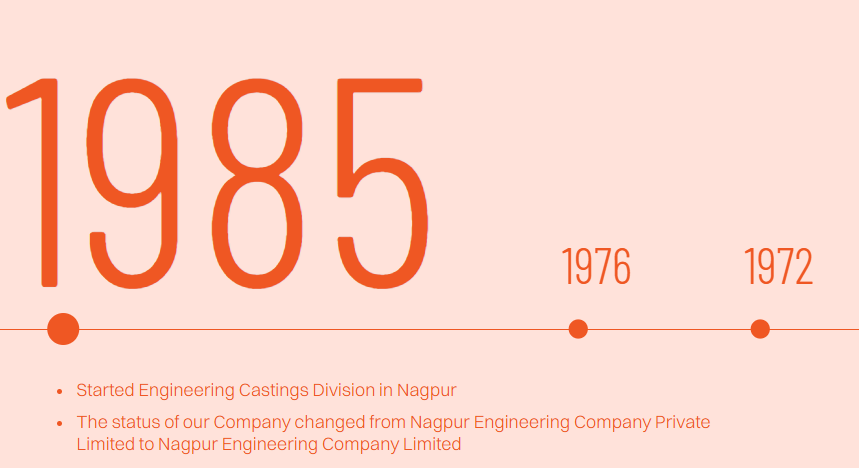
In 1985, a second foundry, the Engineering Castings Division, came up in Nagpur.
Source: Company Website
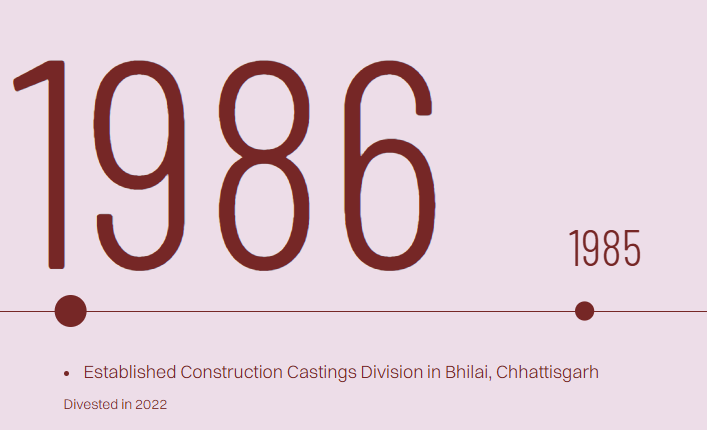
A year later, the company crossed into Chhattisgarh by setting up a new Construction Castings plant in Bhilai.
Source: Company Website
This unit made heavy castings for infrastructure projects and rode the wave of India’s growing construction boom.
By the early 1990s, Jayaswal Neco had started looking beyond its early strengths. In 1991, it established an Automotive Castings Division at Butibori on the outskirts of Nagpur. The new unit made precision components like engine blocks and brake drums for the automobile industry.
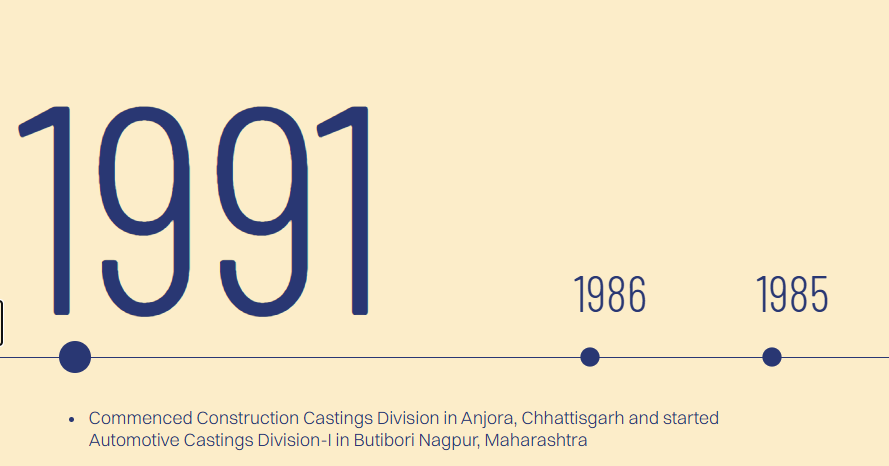
Source: Company Website
With that, the company’s reach widened. It was now supplying not just to municipalities and engineering clients, but also to automakers. Each division, whether centrifugal pipes, engineering castings, construction castings, or automotive castings, added a new layer of capability.
In 1995, it went a step further and it got listed on the Bombay Stock Exchange and the National Stock Exchange. The listing was a turning point. It gave the company access to new capital and marked its arrival in India’s formal corporate landscape.

Source: Company Website
A few years later, the name changed, too. In 1998, Nagpur Engineering Company became Jayaswals Neco Limited. By the close of the 1990s, the company had become the flagship of the larger NECO Group of Industries, known across India for its foundry and casting expertise.
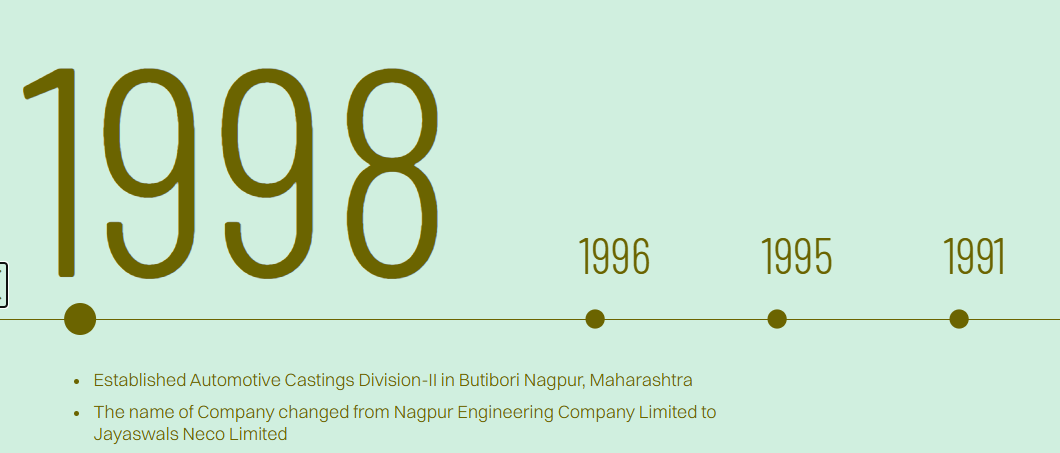
Source: Company Website
By the mid-1990s, the management of Jayaswal Neco found itself at a crossroads. The castings business was steady, but competition was rising. Every new player entering the market made it harder to stand out. To move ahead, the company needed more control over costs, quality, and its own supply chain. That was when the idea of vertical integration began to take shape.
Instead of relying on others for iron and steel, why not make them in-house? A dream of every Metal company, right? If the company could produce its own raw materials, it could feed its foundries more efficiently and gain better command over quality.
In 1996, Jayaswal Neco took its first bold step in that direction. It commissioned an integrated steel plant at Siltara near Raipur in Chhattisgarh.
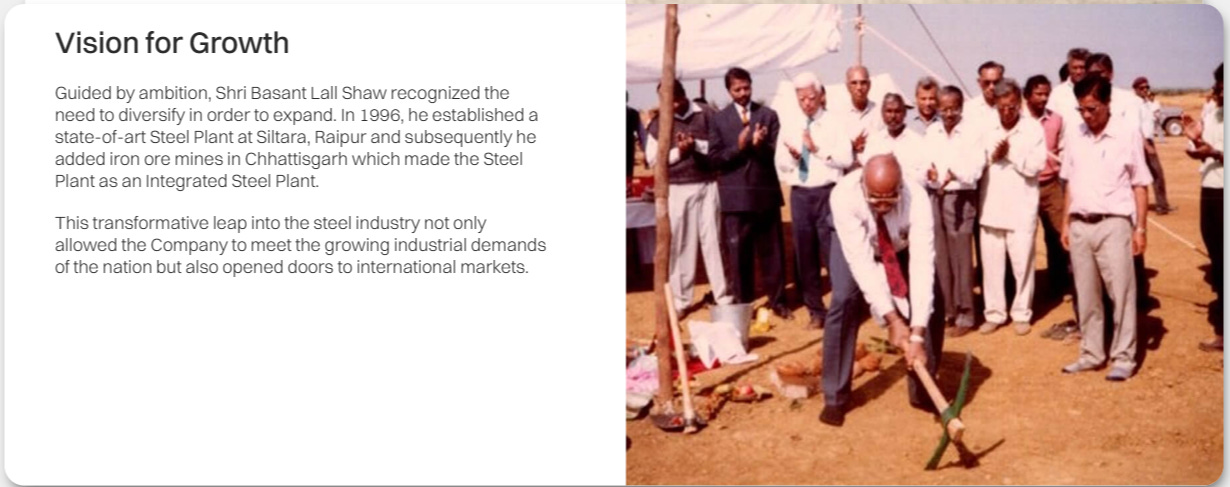
Source: Company Website
There was also a captive power plant of about 15.5 megawatts. It ran on blast furnace gas, the same gas that would otherwise have been released as waste. By 1998, the steel plant was fully operational. Jayaswal Neco had officially entered the world of primary steelmaking.

Source: Company Website
To keep this new plant running smoothly, the company needed a reliable source of raw material. So, it went one step further and secured mining leases for iron ore in Chhattisgarh. With its own mines feeding the blast furnace, Jayaswal Neco no longer had to depend on the open market. This backward integration was a game-changer. It protected the company from fluctuations in ore prices and ensured a consistent quality of feedstock.
Source: Company Website
The result was a fully integrated model: mining, ironmaking, and casting. All under one roof.
In every system, one piece carries more weight than the rest. Control that piece, and the whole system steadies. For Jayaswal Neco, ore and energy acted like a keystone. Hold them firm, and everything downstream behaves.
Through the 2000s, the company kept expanding and refining this model. One of the early additions was a sinter plant that came up around 2004. It could process about 4 lakh tonnes of material each year. The sinter plant helped recycle iron ore fines, those small particles often wasted during mining, by turning them into coarse sinter that could go back into the blast furnace. It was a decent solution that reduced waste and improved efficiency.
Around the same time, the company commissioned its first steel melting shop with a capacity of a little over 3 lakh tonnes per year. The melt shop took hot metal from the blast furnace, along with sponge iron, and converted it into steel billets. These billets formed the base for making rods, bars, and other rolled products. Together, the sinter plant and the melt shop completed the loop from iron ore to semi-finished steel, all within the company’s ecosystem.

Source: Company Website
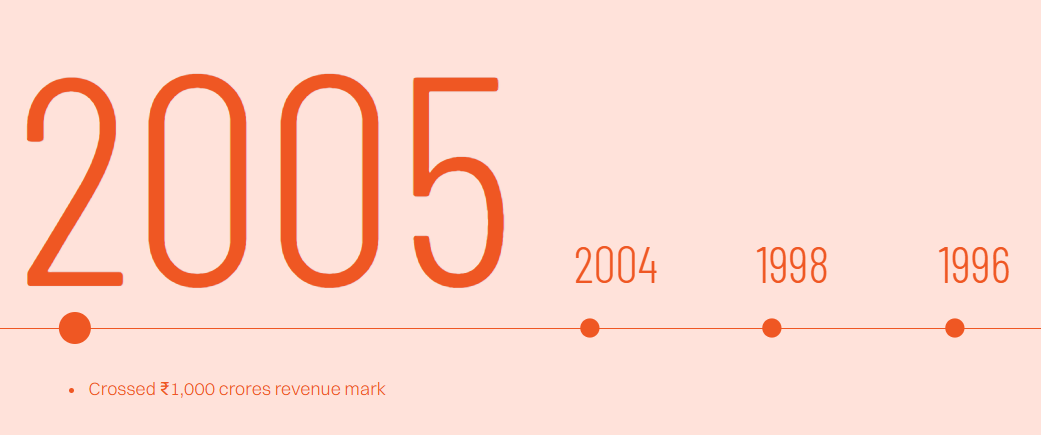
And ultimately, the results spoke for themselves. Through the 1990s and early 2000s, revenues rose steadily. In 2005, Jayaswal Neco crossed a milestone that once seemed distant: 1000 crore rupees in annual revenue. It was a moment that summed up three decades of effort.
Compounding rarely looks smooth. It stays idle, then jumps, then stays idle again. But the work is constant even when the numbers are quiet. The jump only shows what the years have already built.
Source: Company Website
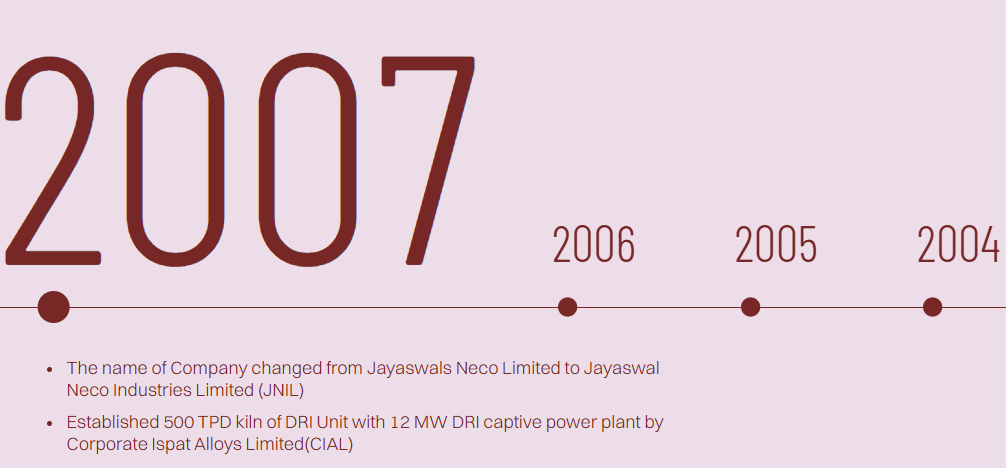
In the mid-2000s, Jayaswal Neco added more pieces to this chain. 2 sponge iron kilns were set up through group entities, each with its own captive power unit. One was built by Abhijeet Infrastructure and could produce about 350 tonnes per day. During this phase, the company also commissioned its own coke oven battery with a capacity of about one lakh tonnes per year. Coke is a crucial ingredient in steelmaking, used as both fuel and reducing agent in the blast furnace. Having its own coke oven meant Jayaswal Neco could produce this vital input independently.

Source: Company Website
Another was installed by Corporate Ispat Alloys and had a capacity of 500 tonnes per day. Both used the heat generated from the sponge iron process to produce electricity.
Source: Company Website
Sponge iron is made by reducing iron ore without melting it. It acts as a substitute for scrap in steelmaking. By producing sponge iron internally, the company ensured a steady and controlled supply of metallic feed for its furnaces.
By the late 2000s, the Siltara complex had become a self-sustaining ecosystem. The mines supplied iron ore. The coke ovens provided fuel. The blast furnace turned that ore into molten metal. The melt shop and rolling mills transformed it into steel products. Captive power units kept the entire operation running smoothly. The company had built an industrial chain that could function with minimal external dependence.
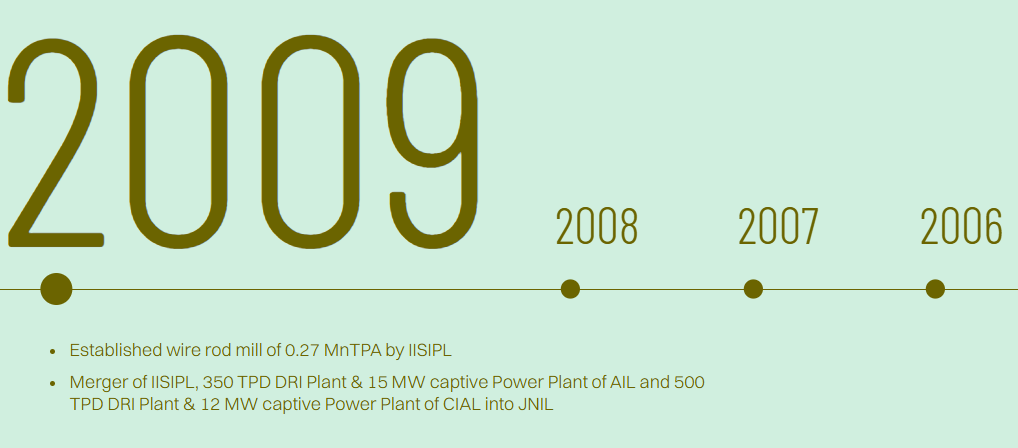
To make this ecosystem more efficient, Jayaswal Neco began consolidating its group companies towards the end of the decade. Between 2007 and 2009, the assets of Inertia Iron and Steel, Abhijeet Infrastructure, and Corporate Ispat Alloys were all merged into the parent company. Each merger simplified management and removed internal overlaps.
Source: Company Website
By 2009, Jayaswal Neco had completed its transformation.
With the steel plant now operational and consolidated, Jayaswal Neco entered the new decade with ambition. India’s economy was booming, and steel demand seemed bound to rise for years. That belief shaped the next phase of the company’s journey.
Confident in its foundation, Jayaswal Neco began another wave of expansion. It would take the company higher in capacity and capability, but the growth comes with a cost. And that deep cost was known as debt. Looking back, this period became a familiar story in the metals world. Growth financed by borrowing, followed by strain when the cycle turned.
It reminds me of The Icarus Paradox. The idea comes from a 1990 book by Danny Miller.
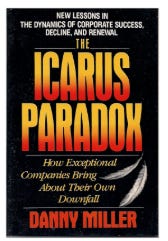
The name comes from the Greek myth of Icarus, who built wings from feathers and wax. He soared high with excitement, but in flying too close to the sun, the wax melted, and he fell. Similarly, Capacity is pride when prices rise. Capacity is weight when prices fall. Wisdom is knowing when to land.
Between 2011 and 2014, the company poured money into its Raipur complex. One of the biggest projects was a new pellet plant with a capacity of 1.5 million tonnes per year. It came online in 2014. The idea was simple. Mining produces large amounts of fine ore dust that cannot go directly into a furnace. The pellet plant turned that waste into value, pressing it into marble-sized balls that could feed the blast furnace efficiently. This not only reduced waste but also allowed the company to use lower-grade iron ore more profitably.
The company also strengthened its steelmaking and rolling capacity. The melt shop’s capacity went up by around 0.65 million tonnes a year, and a new rolling mill was added that could produce about 0.55 million tonnes of bars.
These were long steel products used in construction and infrastructure. For the first time, Jayaswal Neco was not just making billets but finished products ready for the market. To support the higher production, a large oxygen plant of 340 tonnes per day was installed. Oxygen is essential in steelmaking, and having it in-house meant smoother operations and lower costs.

Source: Company Website
Expansion at Siltara continued in parallel. In 2012, the company added another coke oven battery, equal in size to the first, along with a 12 MW waste heat recovery unit. This mirrored the earlier setup and doubled the coke-making capacity, ensuring a steady fuel supply for the larger blast furnace.
Around the same time, the company installed a wire rod mill, adding a new line of products to its portfolio. Wire rods are used in fasteners, springs, and wire products, and they opened a new customer base for Jayaswal Neco.
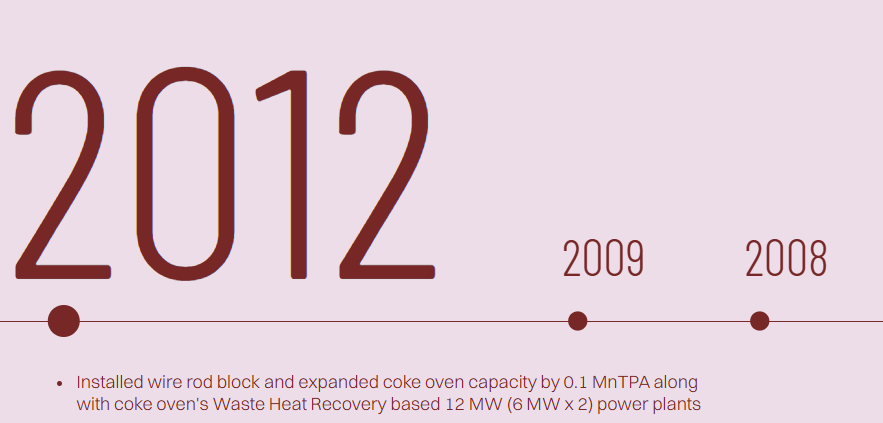
Source: Company Website
A few years later, in 2016, a small but significant bright bar plant came up. It had a modest capacity of 0.04 million tonnes per year, but its products, precision-finished bars used in automobiles and machinery, marked a move into higher-value steel.
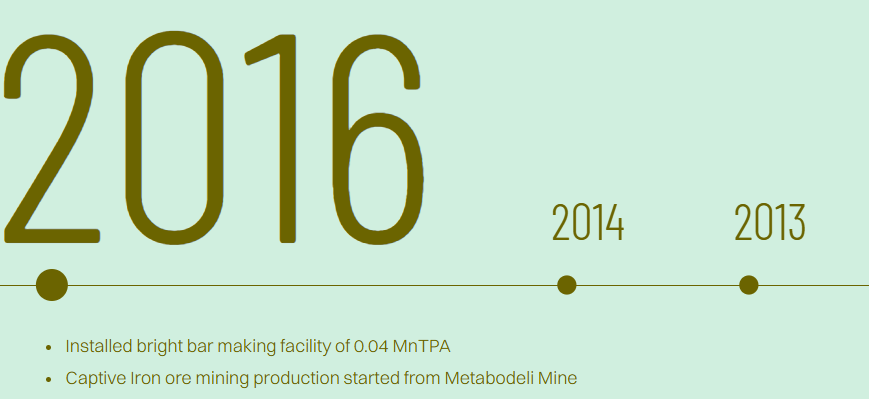
Source: Company Website
These upgrades gave Jayaswal Neco a modern, diversified setup, but they came at a heavy financial cost. Most of the projects were funded by bank loans. Borrowing was easy in those years, and the company expected that future profits would easily cover the repayments. For a while, the optimism seemed justified. But not every project went according to plan.
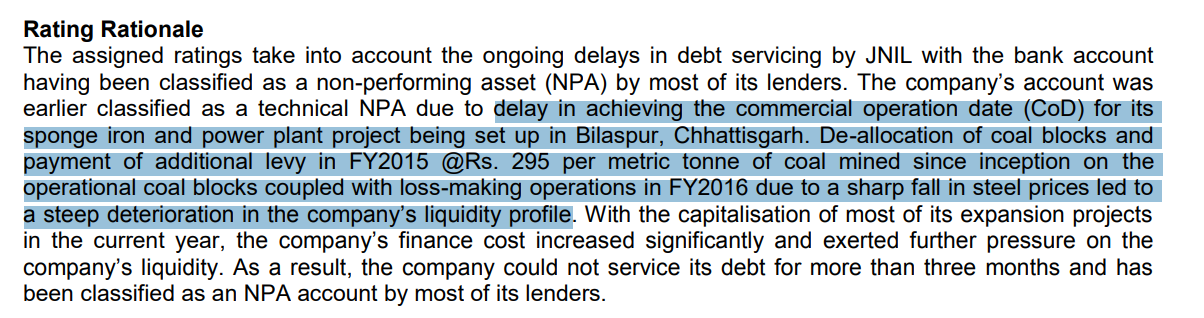
A new sponge iron plant and a 50 MW power project at Bilaspur ran into serious trouble. Construction delays and cost overruns pushed the project off schedule. It missed its commercial start date, and because it was not generating revenue, the loan attached to it was marked as a technical non-performing asset. The delay was more than a technicality; it was the first crack in what would become a deeper financial strain.
Then came an external shock that no one had prepared for. In 2014, the Supreme Court of India cancelled more than 200 coal block allocations after finding irregularities in how they had been awarded.

Source: India Today
Jayaswal Neco was among the companies affected. Overnight, it lost access to the captive coal block that fed its power and coke operations. This forced the company to buy coal from the open market at much higher prices. The blow did not stop there. The court also imposed a penalty of ₹295 per tonne on all coal previously mined from those blocks.
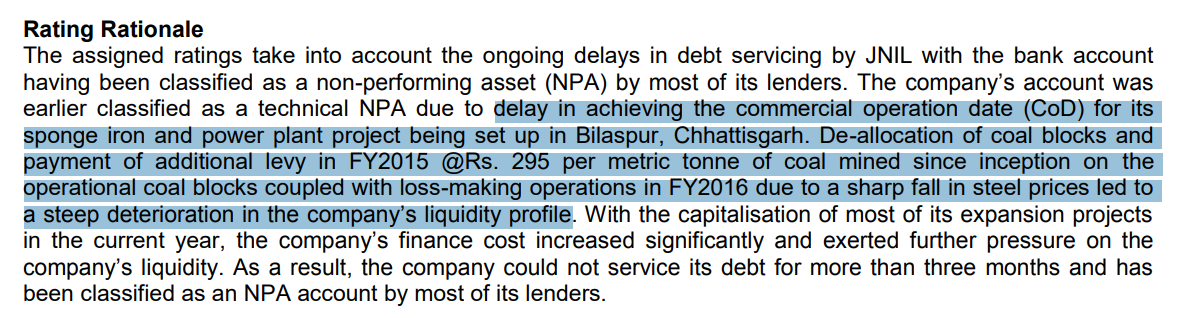
Source: ICRA Credit Rating Report
The timing could not have been worse. By 2015, global steel markets began to weaken. Prices crashed as supply surged and demand slowed, especially with a flood of low-priced steel entering from abroad.

Source: CNBC
Jayaswal Neco had just completed major expansions, but now its new facilities were running below capacity. Selling more steel made little sense when prices were below cost.
In the financial year 2016, the company reported a loss of ₹86.5 crore. The pressure of interest payments grew heavier each quarter. Fixed costs from the new plants stayed high, while revenue kept slipping. The math stopped working.

Cash inflows fell short of what was needed to pay suppliers and lenders. By the end of 2016, the company was missing repayment deadlines. The liquidity crunch was no longer temporary; it had become structural.

By early 2017, most of Jayaswal Neco’s borrowings had become NPA. It was a dramatic turn for a company that, just a few years earlier, had been among the fastest-growing names in India’s private steel sector.
The assets were there: mines, furnaces, mills, and power units.
But the balance sheet could no longer support them.
By mid-2017, Jayaswal Neco’s financial troubles had drawn the attention of both regulators and policymakers. The Indian banking system was facing a wave of bad loans, and the government, along with the Reserve Bank of India, wanted a decisive clean-up. In June 2017, the RBI released its second list of major corporate defaulters that banks were instructed to resolve without delay. Jayaswal Neco Industries Ltd was among the 28 companies on that list. The instruction was clear. Banks had until December 13, 2017, to either reach a restructuring outside of court or file for insolvency under the new law.

Source: Financial Express
For JNIL’s lenders, this became an immediate deadline. Through the rest of 2017, the consortium of banks worked on a recovery plan. They drafted what is called a Master Restructuring Agreement, or MRA. It was meant to be a full plan for reviving the company by adjusting its loans and operations. But such plans take time, and in this case, time ran out. The MRA could not be finalized and approved by all parties before the RBI’s deadline expired.

Source: Mint
When the deadline passed, the lead lender, State Bank of India, took the next step required by the rules. In December 2017, SBI applied to the National Company Law Tribunal in Mumbai. If accepted, it would have suspended the company’s board and placed control in the hands of an insolvency professional who would try to find a buyer or liquidate assets to repay creditors. For the promoters, this was the worst possible outcome.

Source: Mint
The management decided to fight. They took their case all the way to the Supreme Court of India, arguing that the RBI had acted too hastily. Their plea was that a restructuring plan was already in progress and that forcing the company into insolvency would be unfair.
In April 2018, the gamble paid off, at least temporarily. On April 16, the Supreme Court ordered a status quo to be maintained. This meant the NCLT could not proceed with insolvency admission. The order gave Jayaswal Neco a window of relief.

The management could continue to run the business and try to reach a deal with creditors outside of court. For months after that, the case stayed in limbo. The NCLT application was neither withdrawn nor acted upon. The company remained outside insolvency but under watch.
The Supreme Court’s order bought time, but not a solution.
Through 2018 and 2019, the company was still burdened with debt and struggling to meet obligations. The earlier restructuring plan had collapsed, so lenders had to look for a different route. One by one, 11 of the 12 consortium banks decided to sell their loans to an Asset Reconstruction Company, hoping to recover at least part of their dues.

Source: Financial Express
The buyer was Assets Care and Reconstruction Enterprise, or ACRE, which is backed by Ares SSG Capital, a global fund that specialises in stressed assets. Between December 2018 and June 2021, these banks sold their loans to ACRE at around 70 to 75 per cent of face value, effectively taking a haircut of 25 to 30 per cent. By mid-2021, ACRE held about ₹5,700 crore of Jayaswal Neco’s debt, making it the single largest creditor and the de facto lead stakeholder in the restructuring effort.

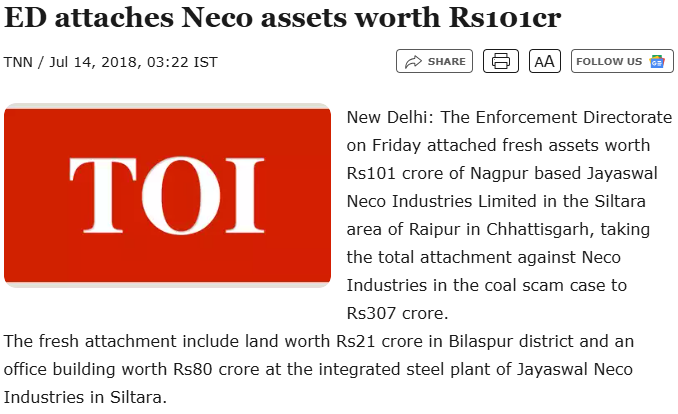
While the ownership of the debt was shifting, the company was also dealing with older wounds. One major issue was the ongoing investigation linked to the coal block allocation. In 2018, the Enforcement Directorate attached assets worth about ₹307.6 crore belonging to Jayaswal Neco’s sponge iron plant under the Prevention of Money Laundering Act. The charge was that the coal block had been obtained improperly during the earlier allocation process. The company appealed the attachment and managed to get a stay from the appellate tribunal, allowing the plant to continue operating.
Another problem was the stalled Bilaspur project. The large sponge iron and power plant there had never been completed and had become a financial drain. In 2019, the lenders officially categorised it as a non-core asset, meaning no further funds would be allocated to it. The company eventually wrote down its investment in this project, recording an impairment loss in FY2020. This decision was painful but necessary, allowing Jayaswal Neco to focus on its main operations in Raipur and Nagpur, which still generated cash flow.

By mid 2021, almost all of Jayaswal Neco’s loans had come under the control of ACRE. For the first time in years, there was alignment between the company and its creditors. ACRE wanted to recover value, and the promoters wanted to save the business they had built. Both sides needed a plan that could realistically work.
In August 2021, the breakthrough arrived. Jayaswal Neco and ACRE signed a Restructuring Support Agreement to address the entire ₹5,700 crore debt load.
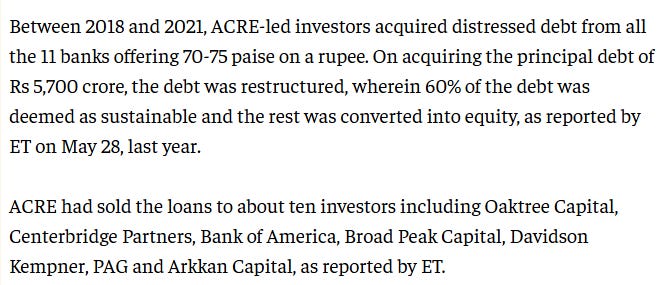
The plan was practical and balanced. It divided the total debt into two parts. The first part, about ₹3,140 crore, was considered sustainable, something the company could actually service over time.

The sustainable portion stayed on the books as debt but under friendlier terms. The unsustainable portion, however, was removed altogether by converting it into equity shares. This single move changed the entire balance sheet.
The ₹2,280 crore conversion turned debt into ownership. Liability became equity. Obligation became alignment. The meter slowed, and attention shifted to cash, not clocks. That is how a balance sheet learns to breathe again.
The shares were issued to ACRE and its investors, giving them about 31.44% of the company’s equity. The promoters saw their stake diluted, but they still retained control. It was a delicate balance. ACRE became a major shareholder, yet the founding family remained at the helm.

By 2022, the turnaround had formally begun.
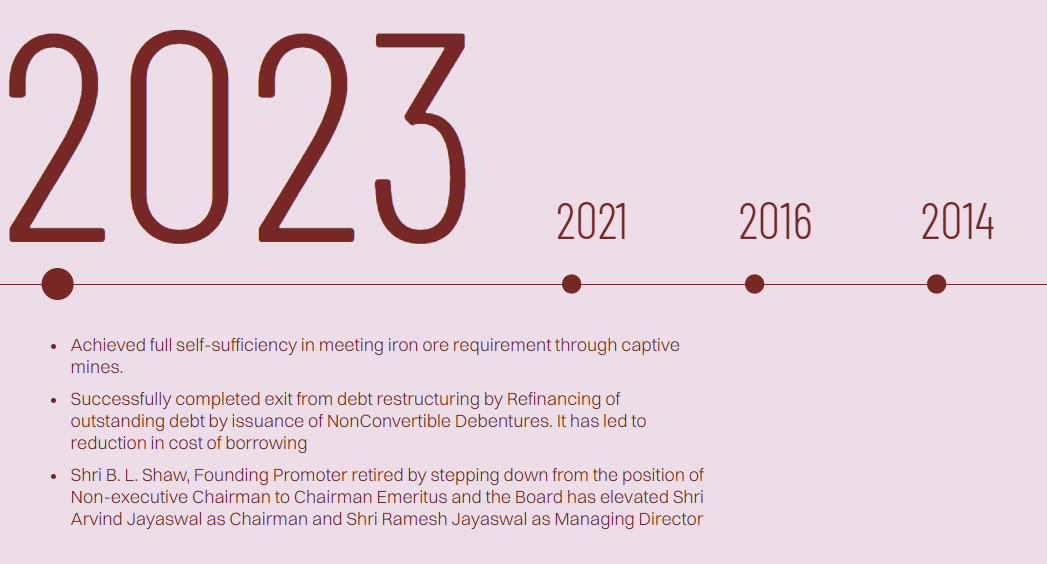
Then came a generational moment. In 2023, after nearly five decades at the helm, founder Basant Lall Shaw decided to step aside. He retired as Non-Executive Chairman and was named Chairman Emeritus. Leadership passed to the next generation.

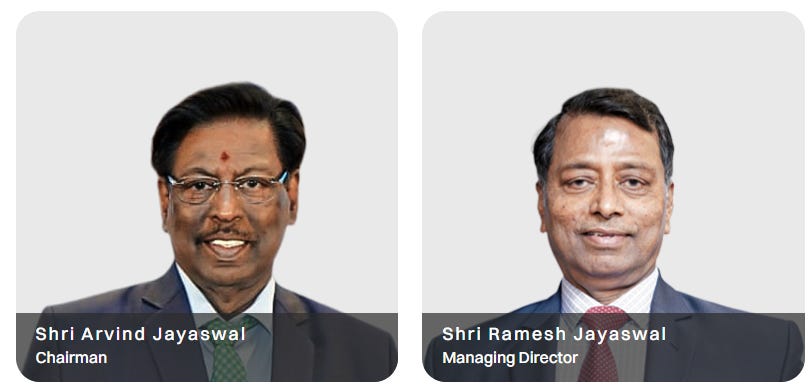
Arvind Jayaswal took over as Chairman, and Ramesh Jayaswal stepped in as Managing Director. Both had been deeply involved in the business and understood its history as well as its challenges.
With the financial restructuring complete and the threat of insolvency finally behind it, Jayaswal Neco entered 2023 on the front foot. The timing could not have been better. The steel cycle was just starting to turn up again. After the turbulence of the mid-2010s and the slowdown that followed the pandemic, India’s steel demand was rising. Prices were firm, and sentiment had turned positive. For Jayaswal Neco, this was the first real tailwind in years.
A key reason the company could capitalise on this upturn was the integration it had patiently built over decades. In 2021 and 2022, many steelmakers were hit hard by spikes in iron ore and coal prices. Jayaswal Neco was better placed. Its captive mines, coke ovens, and power units gave it insulation that others lacked.
A milestone came in 2023 when the company became fully self-sufficient in iron ore for the first time. It’s two mines in Chhattisgarh, at Metabodeli and Chhotedongar, together produced enough ore to meet 100 per cent of the Raipur plant’s needs. For a steelmaker, that kind of independence is gold. It meant no dependence on volatile market prices and no risk of supply disruptions.
Costs were predictable, and margins began to improve.
As production rose, the change showed up in the numbers. In the April to June quarter of 2025, the company reported a profit after tax of ₹93 crore. A year earlier, the same quarter had shown a loss of ₹32 crore. Within a year, red ink had turned to black. In the January to March quarter of 2025, Jayaswal Neco had earned about ₹102 crore in profit. Revenue followed the same curve.
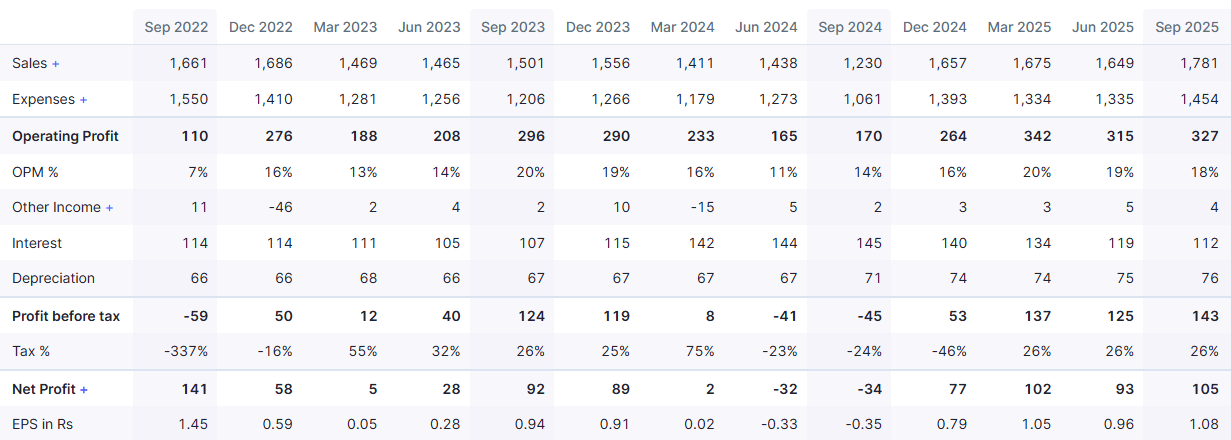
Margins told the deeper story. Better control over raw material costs played a big part. Using 100 % captive iron ore lowered input expenses and cushioned the company against price swings. The product mix also improved. And with demand strong, it could pass on cost increases without losing customers. The pricing power that had vanished in the downturn had returned.
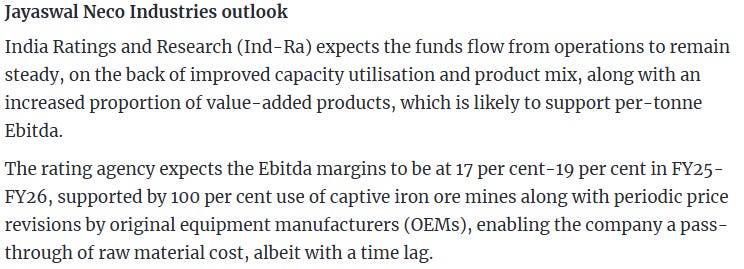
Source: Business Standard
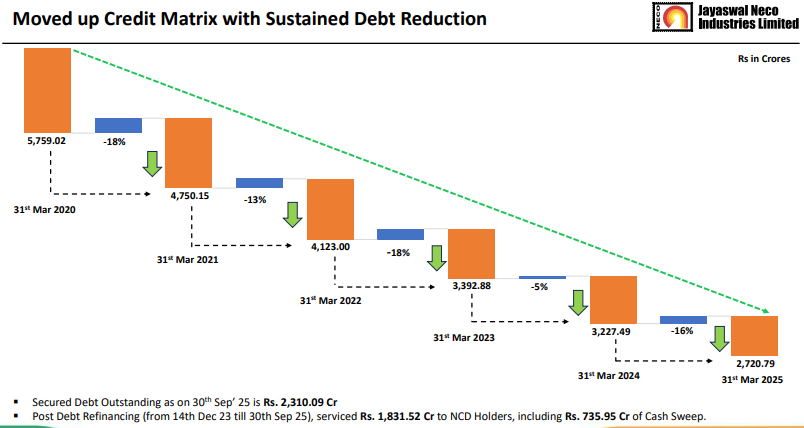
With profits returning, management turned its focus to the balance sheet. The scars of the debt crisis were still fresh. The goal was simple: reduce debt as fast as possible. Through late 2024 and 2025, the company directed much of its cash flow toward repayment. By June 2025, total secured debt had fallen to ₹2,557 crore, down from ₹3,227 crore at the start of FY24-25. In less than a year, Jayaswal Neco had trimmed around ₹670 crore of debt.
Meanwhile, ACRE, which had entered the story as a rescuer, began its exit. With the company’s health restored and the stock price recovering, ACRE and its co-investors started selling their 31 % equity stake. The process was gradual, spread over 2024 and 2025, to avoid unsettling the market. By September 2025, reports confirmed that ACRE had fully exited. For the promoter family, this was closure of a long and difficult chapter.

By mid-2025, the finance team had put together a refinancing plan. The idea was to replace the old, expensive, non-convertible debentures with new loans at far lower interest rates. The board approved the early redemption of the entire ₹3,200 crore of outstanding NCDs by the end of 2025, two years before they were due. The right to redeem them early was built into the terms of the debenture deed dated December 7, 2023. On August 12, 2025, the company sent a formal notice to the debenture trustee, declaring its intention to repay the entire amount along with accrued interest by December. It was a bold decision, one that showed confidence in its improved liquidity and credibility.

Source: India Ratings & Research
This move was possible because of two things. The first was stronger internal cash generation. Profits from the 2024 and 2025 financial years had built a reserve that could be used for repayment. The second was access to new, cheaper capital. Banks that had once refused to lend were now offering fresh loans at normal rates. Rating agencies had already factored this into their outlook. The high-cost debt would soon be replaced with lower-cost financing. Once this refinancing is completed, Jayaswal Neco’s annual interest outgo will fall sharply, saving several tens of crores each year. In practical terms, it means more cash available for reinvestment or further debt reduction.
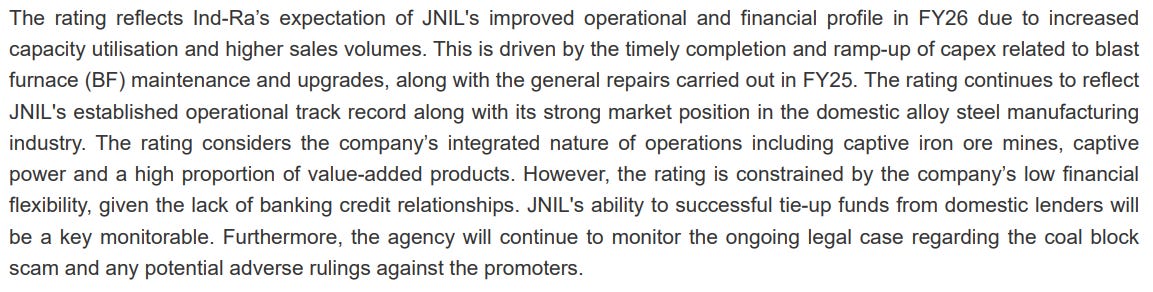
Source: India Ratings & Research
Meanwhile, most of the legal overhangs from earlier years have faded. The Supreme Court case that once kept the company out of insolvency was withdrawn in 2022 after the successful restructuring. The old coal block investigations have largely receded into the background. The assets linked to those cases remain operational, and the company continues to cooperate with authorities while focusing on business stability.
As the dust settles, Jayaswal Neco’s leadership is visibly more measured. Growth will come, but not at the cost of financial discipline. The integrated steel plant at Siltara, with its captive raw materials and self-contained energy sources, gives the company a strong foundation. The focus now is on efficiency, margin improvement, and value-added products rather than raw scale.
More than fifty years after its modest beginning in Nagpur, Jayaswal Neco stands as a symbol of industrial resilience. It has lived through cycles of growth and crisis, of leverage and repair, and emerged more grounded each time. As it steps into the late 2020s, the company is not chasing volume for its own sake. It is focused on building strength quietly, through discipline, integration, and endurance, much like the steady flow of molten iron in its furnaces that never stops, just finds new shape with time.
The metal cycle has a rhythm of its own. When it turns, the rise is always sharp, almost euphoric. Prices run before logic can catch up. But the real test is not in that run-up. It is in the years before it, the slow, quiet seasons when demand fades and balance sheets shrink. Those who endure that phase, who stay disciplined when nothing seems to move, are the ones still standing when the tide returns.
It is not very different from investing, or even life. The biggest wins come to those who simply survive long enough to play the next upcycle. Because the cycle will always turn again, and when it does, you don’t need to swing harder. You just need to still be at the crease.
Disclaimer: Zen Nivesh - No Holding, Harshal/Writer - No Holding. No Recommendation to Buy/Sell.
P.S. All good things eventually come to an end, like this blog. :) Similarly, our FESTIVE discount offer and early access combo offer have ended. But you can still become our Zen Nivesh member by opting for the same below:
I am a big fan of Anurag Kashyap because of his story telling in his movies.
Here I found another Anurag Kashyap (Harshal Mehta). Always write in the easiest yet very powerful story telling format.
Once one starts reading, can't leave any blog in between. And these blogs give so much clarity about a company which we can't get even after a lot of readings.
It shows a lot of hard work in data collections, lots of Annual reports readings, lots of news gathering..it takes a lot of time and energy to get all these details.
More power to Zen Nivesh and entire Team 👍👍💝
Loved reading your articles of late- great work Zen Nivesh and Harshal