


Teachers’ Day just passed by. So, let me start this piece with a small tribute to all my teachers. The quote below beautifully captures the role of a mentor, a teacher, or a master in the life of a student or apprentice.
“The principle is simple and must be engraved deeply in your mind: the goal of an apprenticeship is not money, a good position, a title, or a diploma, but rather the transformation of your mind and character—the first transformation on the way to mastery.” - Robert Greene
A student of investing, like you and I, should also behave like that apprentice above. And we should never forget what we have learned from our teachers. The best tribute you can give to a teacher is to make his/her teachings an integral part of your work. I am making an attempt in that direction. About 14 years ago, one of my teachers, Prof Sanjay Bakshi, went on a long streak of blogs and presentations about just the M word. In fact, he did a couple of detailed presentations on the F word too. I am not making this up. Find the proof here and here. And inspired by him, I have been writing on another M word for the last many weeks and months. But today, I will take a break from that M word. I want to wear the hat of an investor for whom the whole ocean of 5400+ listed businesses is there to drink.
I will come to the main subject in a bit. Before that, I wish to take you to a completely different tangent. A wise man, Tony Seba, made a bold prediction in his 2014 bestselling book, “Clean Disruption of Energy & Transport.”
By 2030, up to 80% of urban parking spaces would become completely redundant, and that 95% of passenger miles would be served by autonomous, on-demand electric vehicle fleets (robotaxis).
And here we are in 2026. While there has been a rapid progress on EV adoption and autonomous vehicles, the world has evolved in a far more different way. The current view of the world is not a clear win for EV or fossil fuels. It is a far more inclusive strategy.

If you read this wonderfully researched piece, you will realize that the real world is far more complex than what we think. It is neither black nor white. Most of the time it is grey. And the world evolves and compromises on a practical solution. Not an ideal one. That is why climate action and energy security go hand in hand. Fossil-fuel reserves are concentrated in a few countries. And they are harmful to the environment. So, constraints in critical minerals, refining capacity, and power grids create a unique situation. Renewables must be combined with cleaner fossil-fuel technologies to make a diversified mix. And most importantly, peaceful relations and open trade remain critical for long-term energy security.
We should take out a leaf or two from the above in our world of stock market. To have a far more inclusive way rather than polarization. Ever since September 2024, the great Indian debate of largecap vs smallcap has been doing the rounds. In my opinion, it is a futile discussion to begin with. And what follows from now is an attempt to prove what I just said. Yes. I know. I know. I suffer from my own limitations and biases. So, hit me up in the comment section. I welcome your constructive criticism.
Let’s start from the basics. The AMFI India portal shares a list of largecaps, midcaps, and smallcaps as on 30th June, 2026. 5400+ stocks have been neatly segregated as per SEBI definition.They are all ranked as per market capitalization. The top 100 are large caps. The next 150 are midcaps. And all the other 5100+ businesses are smallcaps. The average market capitalization of the six months from 1st January 2026 to 30th June 2026 has been taken for the calculation.
We, at Zen Nivesh, dug deeper. We took the data from the screener. Hence, what you see below is not based on a six month average market capitalization. But on the basis of the market cap as on 4th September 2026 after market close. Also, we used Google Finance to get the share price of each company from Covid lows and the latest share price. So, there are a few companies, most of them being tiny obscure nano cap companies, where some data is missing or incorrect. You can download the whole excel sheet with all the workings here. However, here, I will dwell upon a few important observations. Here is a comparative table I made from the above data which might interest you.

Note that there are 5100+ businesses in the smallcap universe. But I have cut the long tail of all the businesses that are less than INR 500 cr marketcap. And hence, in the above table you see only 1772 smallcap businesses as compared to 5100+ in total. I always prefer median values over average values. The reasoning is simple. Averages often get distorted due to outliers. For example, the average returns for the 100 largecap stocks from their covid lows is shown above as 3200%. This didn’t make any sense to me. And when I investigated, I found that three stocks, Hitachi Energy, CG Power & Industrial Solutions, and BSE Ltd contributed disproportionately to this average returns of 3200%. That is why the median returns of 378% makes much more sense to me.
Now here are my few observations:
Midcaps are most expensive on a relative basis.
Large caps do not look cheap optically. But they have gone through a time correction over the last two years.
Smallcaps are still the least expensive despite having such a long list of 1772 companies in their group.
The median returns of 153% from covid lows for a group of 1772 companies speak a lot about the potential of the top few hundred companies in this group.
With a median market cap of INR 2625, there is still a lot of scope for select small businesses to do well from here.
If we extend this argument further from price and valuation to business characteristics, I would urge you to refer to this wonderfully researched article.
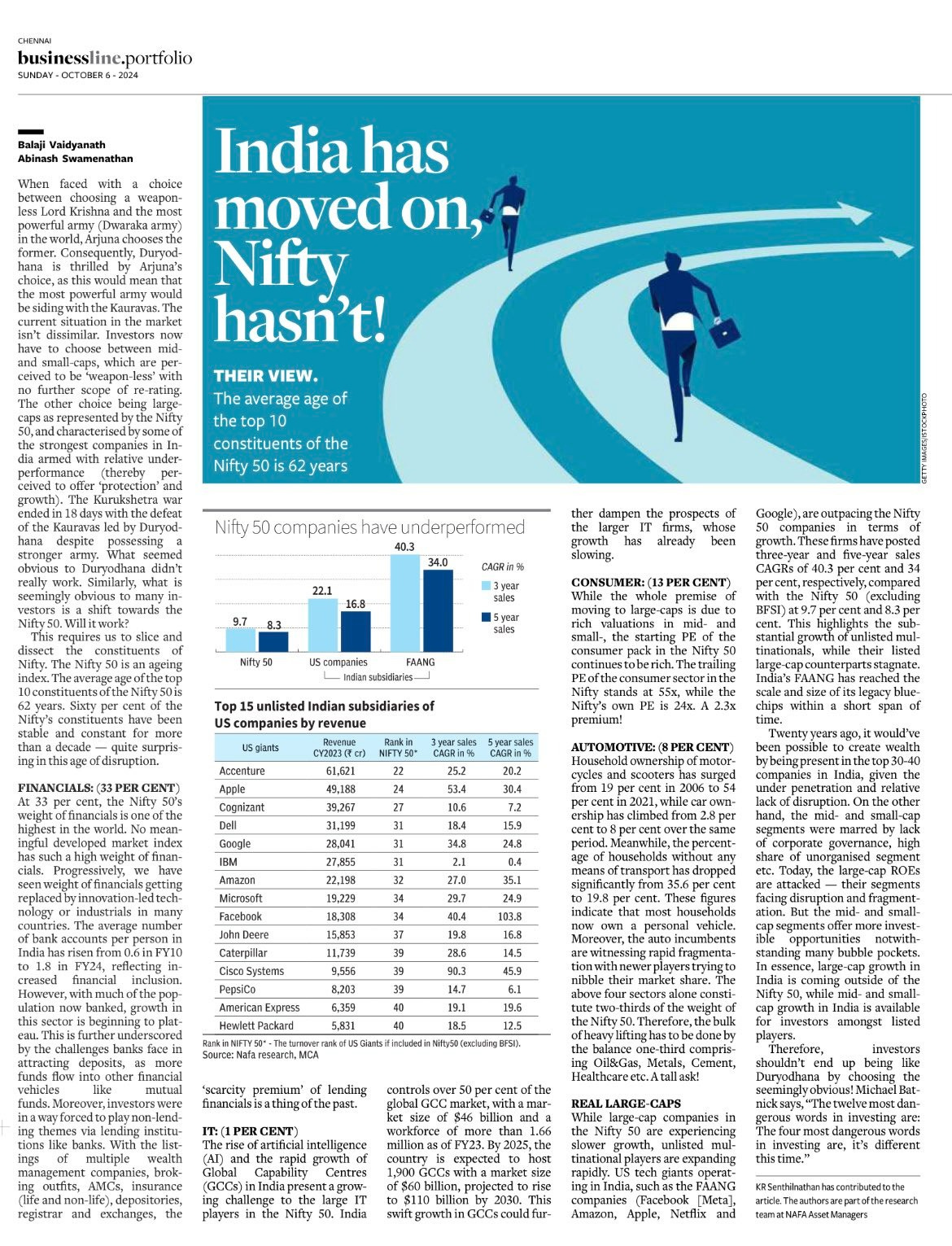
At that time when the above article was written, the consensus was that largecap should do better than smallcaps over the next two years. Fast forward two years. NIFTY50 is still struggling to cross its previous high. And Smallcap index has made fresh highs. And as the smallcap index is a very wide one, stock specific rallies for the smallcap space in the last two years have been mind-boggling.
However, two things have happened for the NIFTY50 that are worth noting.
Two years of time correction despite decent growth in fundamentals.
The composition of NIFTY50 has slowly changed in the last two years.
Trent, Bharat Electronics, Jio Financial Services, Zomato, Indigo, and Max Healthcare came into NIFTY50 in the last two years. At the same time, Divi’s Lab, LTMindtree, BPCL, Britannia, Hero Motorcorp, and INdusInd bank went out. Moreover, I can see a few new age businesses entering the large and mid cap space in a very short period of time. So, I would not be surprised if the NIFTY50 composition will go through more change in the subsequent years.
I believe that the mean-reversion is probably round the corner for NIFTY50 and largecaps. Having said that, the real tailwind in my mind continues to be with the smallcaps. Smallcaps see strong forces from both the demand and the supply side. At the demand side the number of demat accounts have exploded in the last 5 years. On the supply side, there has been 1000+ SME IPOs and 400+ main board IPOs since January 2020. Having said that, individual stocks in both the spaces will keep surprising on the upside.
Whatever I have shared with you until now is from the point of view of an alpha-seeking stock-picker. Now let’s shift gears. Let’s think from the perspective of a layman whose passion and skills lie outside the stock market domain. She is just in her 20s. 30+ years of compounding in life is statistically pending for her. And she wants to avoid the biggest financial risk of her life. To stay away from any exposure in Indian equities. For her, there are two options. I will start with what I consider the best. Go for a broad index fund. NSE top 500 or top 750 just like the S&P500 in the USA. A broad index fund in India is like a basket that contains large, mid and small caps. For example, if you take NSE750, you will have 100 large cap stocks, 150 midcap stocks, and 500 smallcap stocks. Based on Friday’s closing price, the 750th stock there would have a market cap of roughly 6600 Cr. The average market cap of these 750 securities comes to around 60,000 Cr. Whereas the median market cap is 21,000 Cr. So, all you need to do is find a passive fund that mimics this index. If 750 looks too wide for you, go for NSE500. But there are several benefits of this strategy of investing in a broad index fund for a layman.
An equity exposure that is a decent representation of the broad Indian economy.
Diversified from the perspective of market capitalization and industry classifications.
No fund manager risk
Cost of investment is minimal due to low expense ratio in index-funds
No tax accrual unless you sell the units of the fund.
If you do not have the time, inclination, and expertise of understanding equities, nothing beats this strategy from the perspective of simplicity, secureness, and soundness. Shut the social media gurus and just follow this over the long term. No need to pay any advisory fees to any exotic financial product.
If, and only if, you think you can trust a friend or a good advisor for the long-term, you may go for active mutual funds over passive. The rule is simple. Your friend or your advisor should be able to help you find good fund managers, who may consistently generate some alpha over the index. Even a 2% alpha [net of all expenses] over a very long period of 20-30 years can generate very high returns. However, always remember that this is easier said than done. The best of fund managers go through a long stretch of under-performance. Deciding when to stick to them and when to switch is not an easy decision for anyone. But if you get hold of a good fund manager at the start of your investing tenure, you may get a very good headstart. If that happens it would be an outcome of a lot of good luck and good research by your advisor/friend. A few thumb rules I would request you to follow here. No thematic or industry specific funds. No small cap or large cap or midcap only funds. Just like a broad passive index, I prefer a multicap active fund where you get a reasonable exposure of all types of market cap and industries.
So, we have covered all corners now. From the perspective of an alpha-seeking stock picker. And also from that of a layman. Now, I want to leave you with a deep thought I recently came across on the internet.
“If an egg is broken by an outside force, life ends. If broken by an inside force, life begins. Great things always begin from the inside.”

Now what can you learn from this? Let me try to explain. If you are an alpha-seeking stock-picker. Stop comparing yourself with others. Not just in terms of returns, but also in terms of style, philosophy, risk-tolerance and so on and so forth. Your job is to look within. Know yourself. Learn from your mistakes. And keep gaining new insights for your own world of investing. Somebody somewhere in this world is always going to be smarter than you. That may logically mean a higher CAGR generating machine. So, what? Do you want to end your life due to an outside force? Or enrich your life with the help of an inside force? The choice is yours.
Similarly, if you are a layman whose skills and passion lie outside the stock market, your inner force should be directed towards beating inflation handsomely over the long run. Period. Anything above that is a bonus. Whenever that bonus arrives, welcome it with both hands. But you cannot build that into your expectation model.
If you keep things simple like this, you would probably agree with me that this endless debate of largecap vs smallcap is of no use. Often people around yourself will make you feel that you are under-optimizing your potential. That is when you would go into the question of this or that. This reminds me of an incident I witnessed a few years back. A smart investor asked this to a wise investor.
SI: Do we buy this stock or that stock and why?
WI: If the risk-reward is in the favour of both the stocks, why “or”? Why not “and”?
If you now connect the energy security [ the “and” strategy] story I shared at the start with this story of two investors, you will probably understand why I think both largecaps and smallcaps will do well. Largecap is probably a mean-reversion candidate. Smallcap is probably a tailwind candidate. My heart may still lie in the microcap space. However, from where we are today, over the next 3-5 years, I think both will do well.
Thanks for reading!
P.S. Know more about Zen Nivesh and our origin story here.
Ok sir ji
Sir ji.... Acc to Screener, 750th company's Mcap is around 1700 cr.. am i wrong ?