
Groww: A Deep Dive
A Megacap Growing like a Microcap Why? And how? ZN Research Lab #58


Investing, researching, and learning, in my mind, are one of the most fascinating pursuits in life. More so in today’s world when you have AI tools to feed into your curiosity and keep you on an endless loop of back and forth on ideas. But I have always believed that the real learning happens when you go deep. When I watched my first Christopher Nolan movie, The Prestige, for the first time, there was a burning desire to watch all his movies. I had the same pursuit while watching cricket in my younger days. I tried to go deep into the life of my favourite cricket stars. To figure out how they’d think, what motivated them, and most importantly, what kept them going. All the time. And this nagging habit of going into the depth of things and people that excite me never left me. More so when I entered the field of investing. Be it Buffett, Munger, Fisher, Lynch, Professor Bakshi, or anyone else. If I liked them, there was an intense curiosity to go down the rabbit hole and read anything and everything I could find on them. I have had many mentors from as many different fields as possible. I can list down a dozen mentors from different fields I have learned from but maybe that’s for another day. The most striking thing that I recently noticed is that I have never personally met my investing mentors except Professor Sanjay Bakshi. However, I have often felt as if these mentors have sat beside me, explained their thoughts to me for the day’s end, and answered all my stupid and trivial queries.
I know it is a deep dive blog on a business. But I cannot help but start with one of my mentors to begin the blog. Paul Graham.
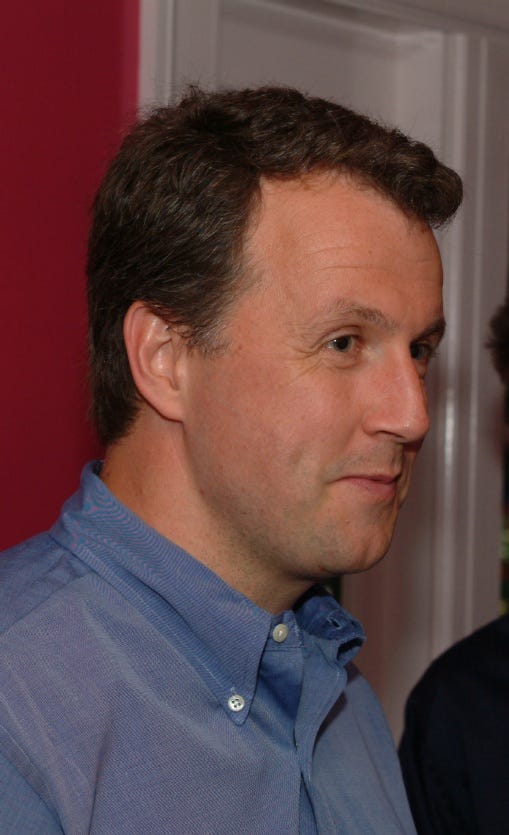
I think it was in 2018 or 2019, when I first came across his essay “Do things that Don’t Scale”. I was just amazed by both the clarity and novelty. However, being an individual public market investor in India, I did not connect with Graham much beyond that. From time to time, a friend would share a brilliant piece. I would read it, like it, and then forget it. Paul Graham funds startups and writes essays that help startup founders to learn from his rich and varied experiences. I did not see any direct relevance of that in my work then. I changed this view later.
Over the last 2-3 years, my focus has shifted primarily to Indian microcaps. While there is no official definition of microcaps in India, we at Zen Nivesh, have defined them as businesses with less than INR 3000 Cr of market cap. Focus on this narrow field serendipitously led me to keep discovering his essays time and again. Paul Graham may keep startups in his mind while writing his essays. An SME or a microcap entrepreneur in India can learn so much from those essays as well. And all for free. And hence, a microcap investor like you and I can learn a lot too. So, in the last one year, I chased his essays like I chased writings of Buffett, Munger, Fisher, Lynch, and Prof Sanjay Bakshi a decade back. My favourite has been The Power of the Marginal. And I have quoted it in many of my previous blogs. If you have looked at hundreds of microcaps over the years and then read that essay of Paul Graham, you can’t help but connect the dots with not one or two microcap businesses but definitely a handful. Paul Graham has written 234 essays. And I have read only 76 of them yet. I just finished counting from his website. One of my goals today is to finish the rest soon. But serendipity works in your life in mysterious ways. I had no idea about Robert Greene, a couple of months ago. Someone quoted from his book in his blog. I do not even remember which blog it was. But mastery and apprenticeship was so deeply connected to me that I immediately ordered the book.
When I ordered the book I just knew that the author has used the real life stories of a lot of excellent practitioners across timelines and professions. I had no idea that Paul Graham is also one of them in the book. Robert Greene drives home a lot of useful life and learning lessons in this book through the stories of Paul Graham and many others. Graham demonstrates through his life, as explained in the book, that breakthrough ideas do not need new technologies. Most of them come from viewing the already available technology in a slightly new way. He hated windows. He did not want to build a software for windows. That influenced him to imagine a software that can run on a web browser. This was in the mid- nineties. Seeds of Viaweb were sown. It later got acquired by Yahoo. He repeated the same curiosity and experimentation going ahead and ended up founding Y Combinator. The real learning for me was the ability to be flexible, adaptive, and curious all the time.
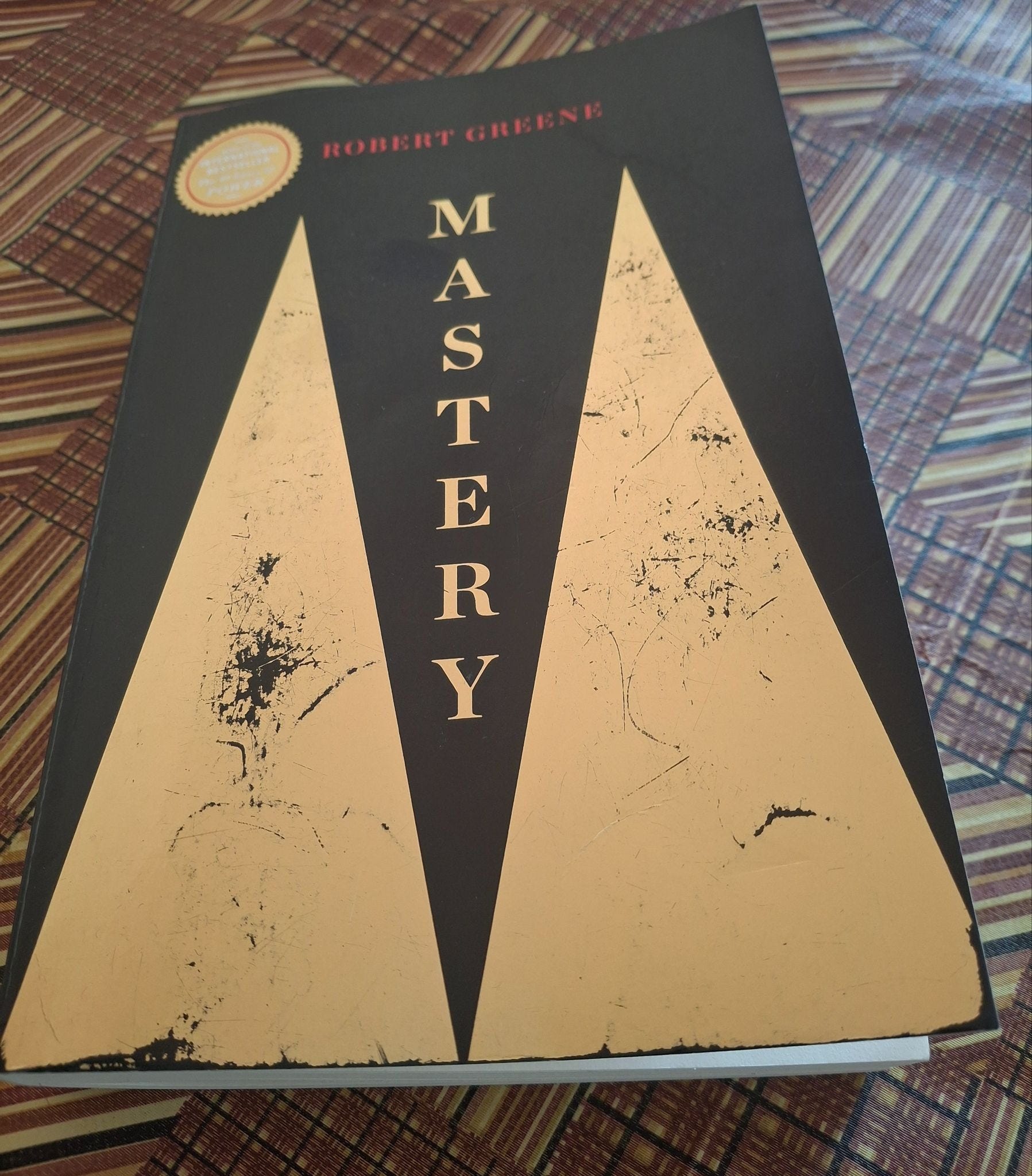
Greene’s portrayal of Graham cemented this thought in my mind that exceptional innovation doesn’t necessarily need a brilliant idea. It is about repeatedly recognizing hidden possibilities in what already exists. And then backing it up with intense curiosity and persistence.
I know the trailer looks longer than the movie. But by the time you finish watching the movie, I hope I will be successful in making you understand the reason for this long start. So, let’s begin.
Groww (Billionbrains Garage Ventures Limited)
If you trace the origin of Groww you will find a few parallels with what Graham’s story says. Four friends at Flipkart quit their jobs with no clear vision. They just did not like how the financial services products were sold in India. Remember, the dislike for Windows for Graham? They just wanted to start as a technology company and figure out what they can do in the financial services space. In one of the interview, Lalit Keshre, the CEO, says this so clearly:
“The vision was to build a tech company in financial services. No idea what we were going to do. But we thought tech will be the core component.”
That’s it. The financial services industry in India needed a restart from scratch. From a technical mindset. Not an incremental move. But a complete overhaul. That’s what Graham’s story also says. Recognizing hidden possibilities in what already exists. With a slightly new way of doing things.
Groww was founded in 2016. Graham’s Y Combinator invested in Groww in January 2018 when it was just one and half years old.
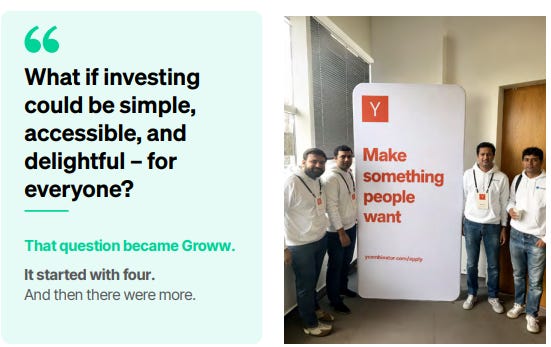
Make something people want. What you read in the snippet above is also picked from this Paul Graham essay. So, YC’s investment happened before any institutional series round began. There was no stockbroking app at that time. Just a direct mutual fund platform.
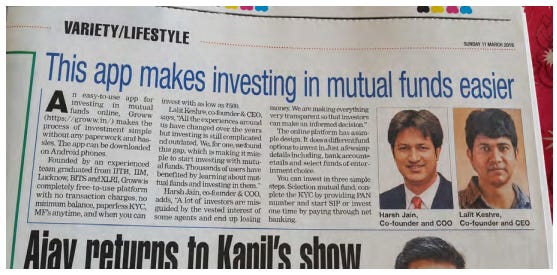
Tech-oriented founders, trying to figure out how to go ahead in the financial world which is dominated by players who do not understand the capability of technology. What we should understand here is that public market investors like you and I notice a business when it has become big enough for an IPO. People like Paul Graham imagine that IPO day 10 years early. When the founders themselves have no clarity where they will end up. And he has been doing this for more than two decades now. And he has been documenting it in his essays along the way. Let’s pick one of them and study the business of Groww from that lens.
The essay is Shlep Blindness. It was written in January 2012. But if you read it today for the first time, you would feel as if it was written for today’s time. And I am sure, 2 decades later, someone will read it for the first time and say the same. Borrowed from Yiddish, it refers to tedious, unpleasant, operationally demanding work. The kind of work you and I postpone. Our mind subconsciously makes a decision to leave them. And we trick ourselves into believing that it is far more efficient to leave out these hard tasks. Graham argues that this is where the largest opportunities are. It is hard to enter any industry dominated by behemoths who appear to have an unfair advantage when it comes to scale, capital, customer, and value chain. And especially in an industry like financial services where the whole value chain is so effortlessly oiled that however hard you try, you don’t get a firm grip and end up slipping to the bottom. But you should look around and see how many small and tiny businesses saw the light of day in the gaps which incumbents didn’t care to fill. I wrote about it here. Sharing a snippet below that shares a few examples from this theme.
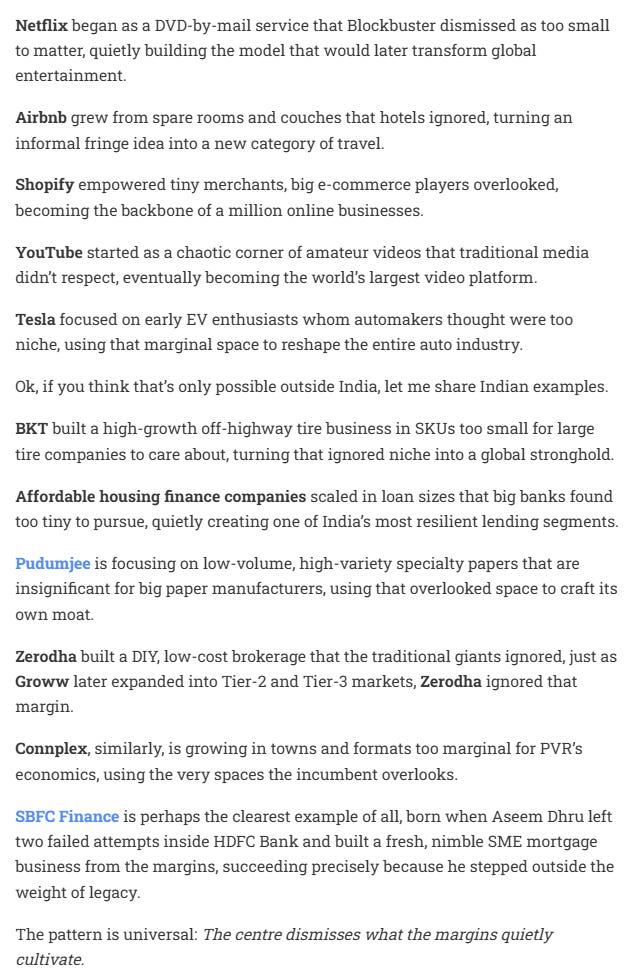
What Paul Graham writes in his essay, Power of the Marginal, is the gold standard for startups and microcap businesses.
“The really juicy new approaches are not the ones insiders reject as impossible, but those they ignore as undignified.”
If you are a bollywood movie buff like me, you would connect the above timeless advice from Graham with this fascinating scene in Gangs of Wasseypur.

The incumbent (Ramadhir) does not appreciate the real threat of an emerging competitor in Sardaar Khan. The efforts of Sardaar Khan were not rejected as impossible, but ignored as undignified. The rest is history.
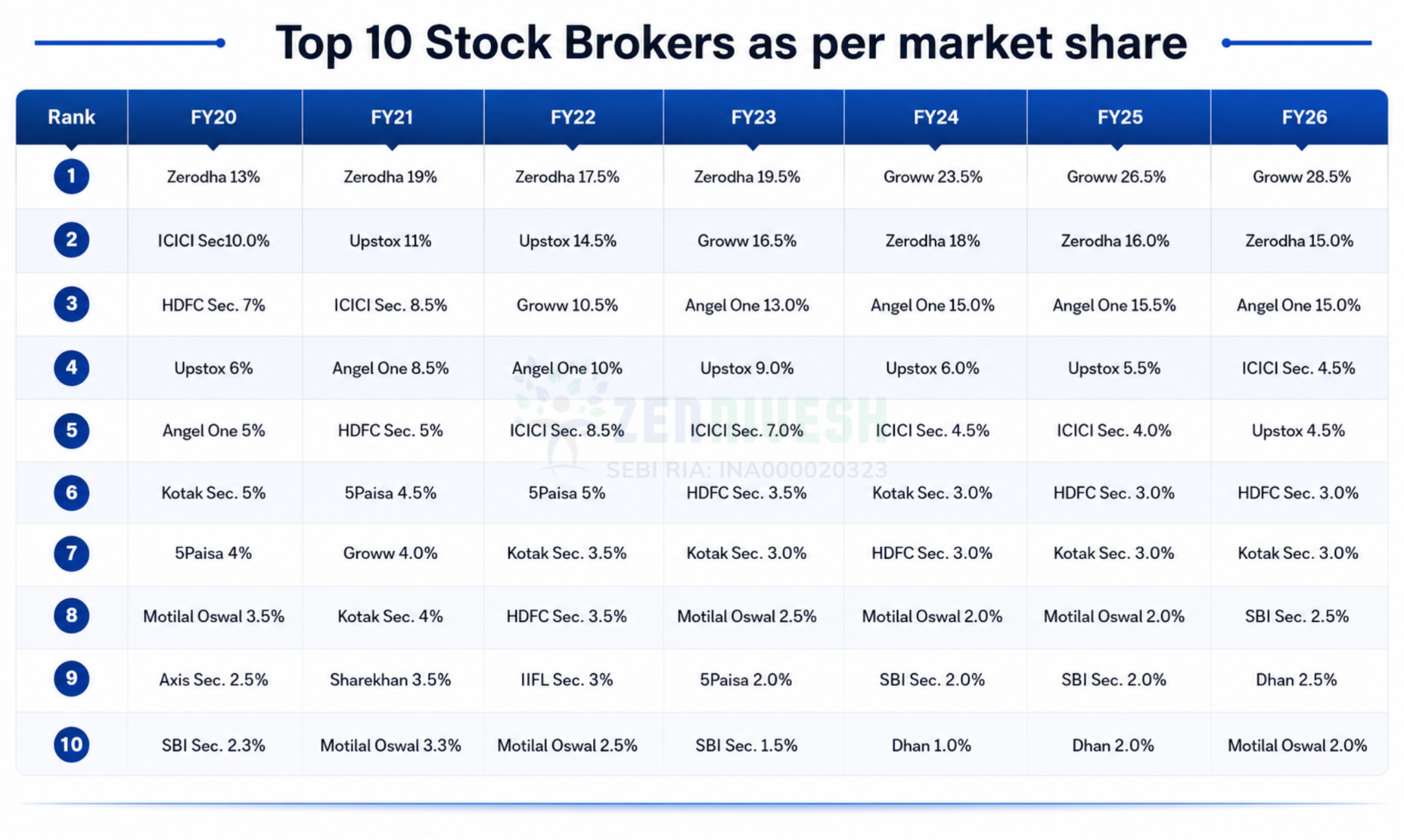
Traditional mutual fund and stock broking businesses also behaved in exactly the similar manner when Zerodha came into the picture in 2010, and Groww in 2016. The incumbents never saw them as any threat to begin with. It’s like what a wise man once said.
“First, they will ignore you, then they will laugh at you, then they will fight you, then you will win.”
If you carefully observe the pre-covid era, the large incumbents never looked at mutual funds or stock broking as a focused standalone business. They were all large banks having a broking and mutual fund business on the side. Their vantage point was completely different. Rather than thinking about the customers, they were thinking about themselves. Even worse, they were milking customers on the name of their company’s brand and reputation. Whenever a business takes customers for granted, disruption is inevitable. It is not a question of “if” but a question of “when.”
Zerodha was the first “when.” Zerodha made a dent into the stockbroking industry in 2010. It focused on a gap that the incumbents ignored as too tiny and irrelevant. A small group of professional traders who did not need a broker’s hand-holding. They needed just two things. A simplistic user interface, and a low-cost broker. Don’t you remember the Paul Graham story? Not a brilliant idea. Just about recognizing hidden possibilities in what already exists. And then backing it up with intense curiosity and persistence. It took Zerodha a decade to become the market leader. But here’s the twist. What Zerodha did once with the stock broking business, Groww is doing repeatedly with every business it is entering into. Consistently recognizing the hidden possibilities in an existing business. And then with intense curiosity and persistence going at full force at them.
Groww launched its stock broking app in June 2020. At the height of Covid scare. During that time it just had one identity. A direct mutual fund platform with millions of customers entering into a stock broking business. And I still wonder, how on earth did they manage to become the largest stock broker in just three years. And while this was happening whenever I discussed Groww with my friends in the public market investing space, everyone would brush it aside as if Groww is not at all relevant. I am talking about 2020-2023. The general perception in the public market about Groww was this:
“VC-backed startup. Burning cash to acquire customers and reach. Nothing special about them. Enjoying the tailwind post Covid. Only when the tide goes out do you get to know who is swimming naked.”
2024 to 2026 has been the most difficult time for the Indian stock market. So, the tide has already gone out a fair bit if you ask me. In fact, India has been almost written off in the global scheme of things. And there are many domestic experts who also aggressively sell global investing. I respectfully disagree with them here. But the fact remains, post Covid, the last two years were the worst in terms of stock market returns and client acquisitions for the industry. Let’s look at who is swimming naked.
The numbers don’t lie.
Now look at their latest Q1FY27 press release.
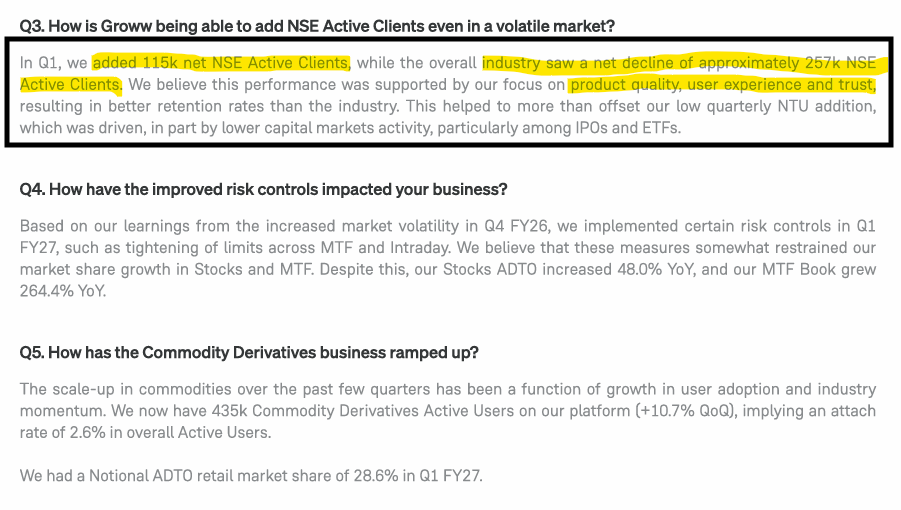
Groww is the largest stock broker in India. It is still growing at such a high speed on an already high base. At a time when industry is degrowing. Doesn’t it raise questions in your mind? And they are not growing mindlessly. Check the snippet above to know how they have proactively become extra cautious in some products like MTF where they see heightened risks in a volatile market like the current one.
Dear gentle reader of this blog, there are two questions you should have in your mind, at this juncture.
What took Zerodha 10 years, how come it took Groww just 3 Years?
What is the real business philosophy of Groww that helps it grow so fast and consistently?
Let’s start with the first question. And I must put a disclaimer here. They are the men in the arena. I am just an arm chair analyst. Writing my thesis with my own limited understanding based on what I have read from publicly available sources. So, expect some inherent biases. However, from where I see this, Zerodha and Groww approached the whole game with completely different mindsets. Zerodha founders were smart stock market traders. They could feel the pain of a sophisticated trader. So, their product was designed for them. And probably, their effort was more towards gaining market share from the incumbents. Kudos to them for tirelessly working against the behemoths without any outside fundraise and in a decade overtaking the incumbents to become the leader. Groww came to stock broking at a different time and definitely with a different mindset. Groww did not just focus on taking market share from the incumbents. The main focus was to grow the market and go to places where nobody has gone before. That is why this campaign of Ab India Karega Groww was far more instrumental than what we see from the outside.
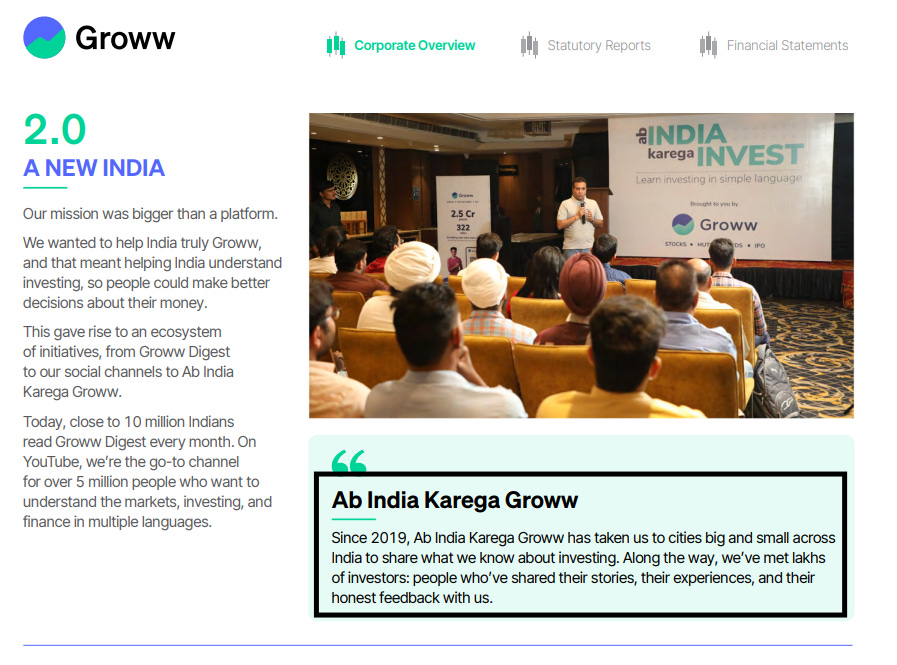
This again brings me back to the Paul Graham essay of “Do things that don’t scale”. Going to tier 2 tier 3 cities and far off places do not give you immediate returns in terms of customer acquisition. So, if you measure those things in terms of immediate cost and sales, it will never make any economic sense. So, yes, VC-funding helped. Social media helped. General increase in awareness on stock markets post Covid helped too. The biggest help was the tailwind in the stock market. But how many businesses managed to take this long-term brand building initiative in the manner that Groww did? I must quote Paul Graham here again.
“The unscalable things you have to do to get started are not merely a necessary evil, but change the company permanently for the better. If you have to be aggressive about user acquisition when you’re small, you’ll probably still be aggressive when you’re big. If you have to manufacture your own hardware, or use your software on users’ behalf, you’ll learn things you couldn’t have learned otherwise. And most importantly, if you have to work hard to delight users when you only have a handful of them, you’ll keep doing it when you have a lot.”
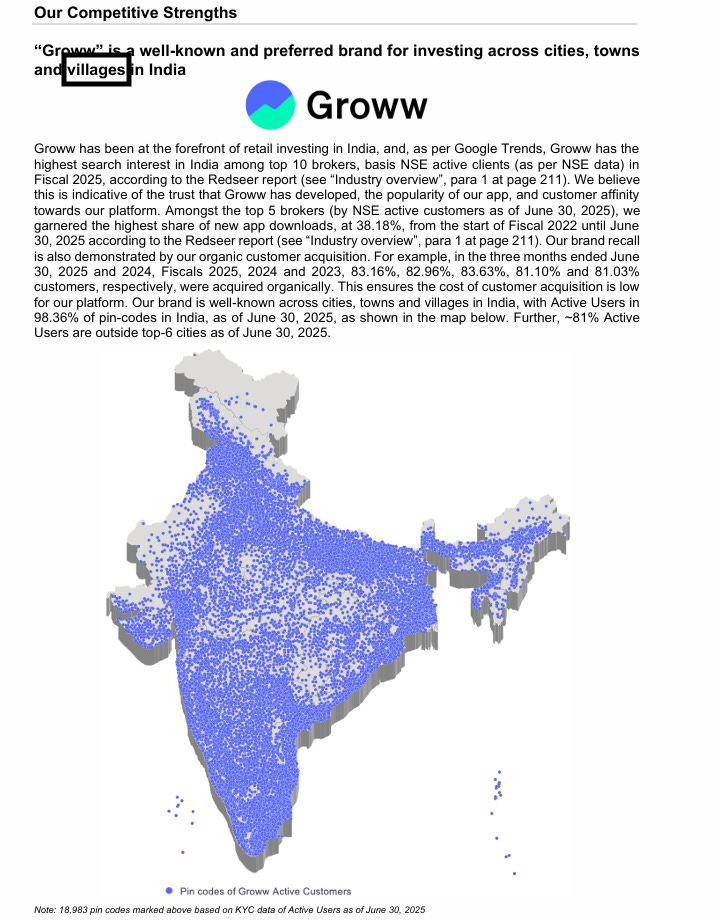
And what did the result look like when they did the unscalable things for a long time?
Now let’s come to the second question. And here’s their blueprint clearly available for everyone.
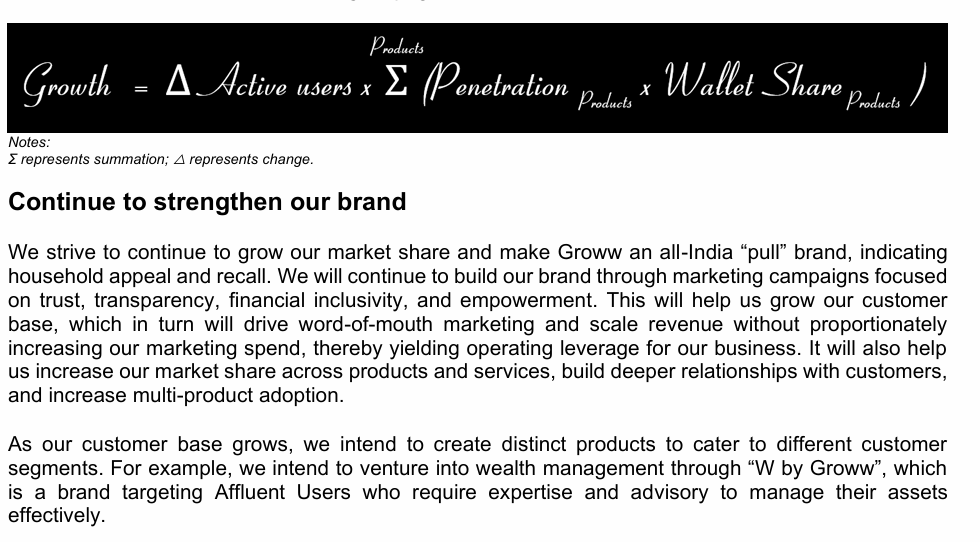
I can sense that the above words may not dazzle many of you. Every other business says that. What’s new? I get that. But remember what Yogi Berra said
“In theory there is no difference between theory and practice. In practice there is.”
Increasing active user base, penetrating the market, and increasing wallet share. They all look theoretical and boring from the outside. If you view it from the lens of a founder, very few manage to do that consistently over a long period of time.
Now let’s look back at the journey of Groww to make sense of all this. At the core of all this, Groww has been successful in making its users find it convenient to do what they were already doing.
First, they made it convenient for users to buy mutual funds. Simple user interface, giving them everything they absolutely need, and removing the rest. Direct plan only. No commissions. Low-cost. It looks obvious today, in the pre-Covid era, it was no less than a magic in the minds of the consumers. Because they were used to seeing Dinosaurs selling mutual funds. Then for the same users and a lot more new users Groww created an investing and trading platform. With the same ethos. Then came fixed income and lending products. Then came its own asset management business. Starting its own AMC was like a distributor becoming a manufacturer in just half a decade. And now you have the personalised portfolio reviews, bespoke strategies and expert-led recommendations through their latest wealth management and advisory offering by the product name W.
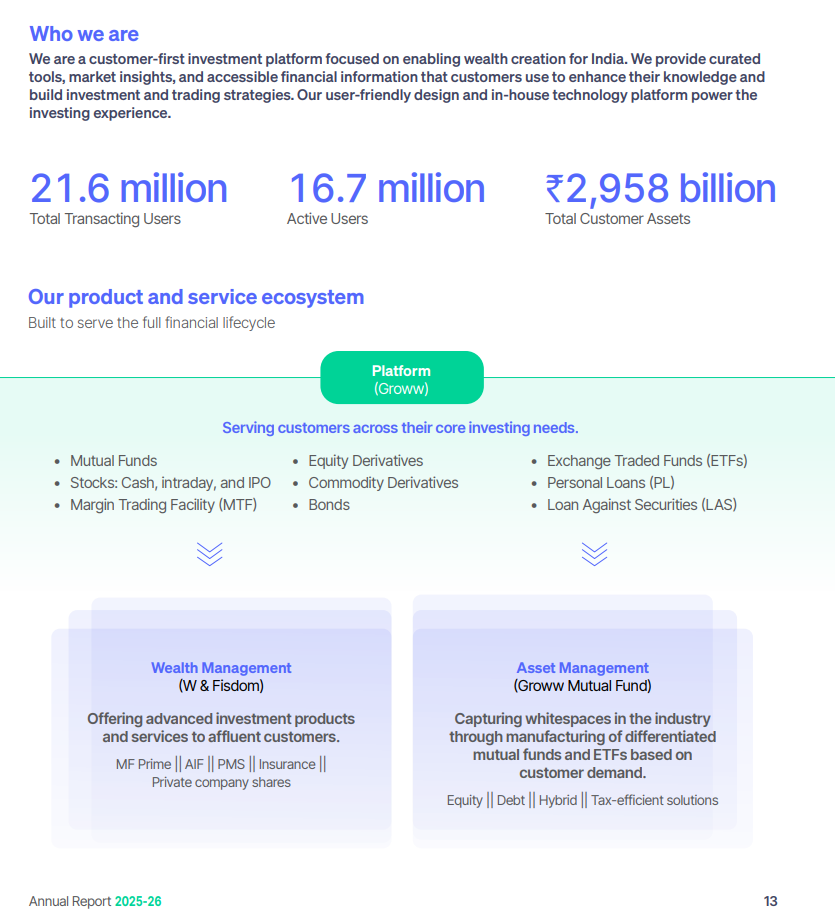
Groww has been successful in growing consistently by practicing what they sought out at the start. Many startups start out in similar fashion. But very few manage to grow like Groww after reaching such a scale.
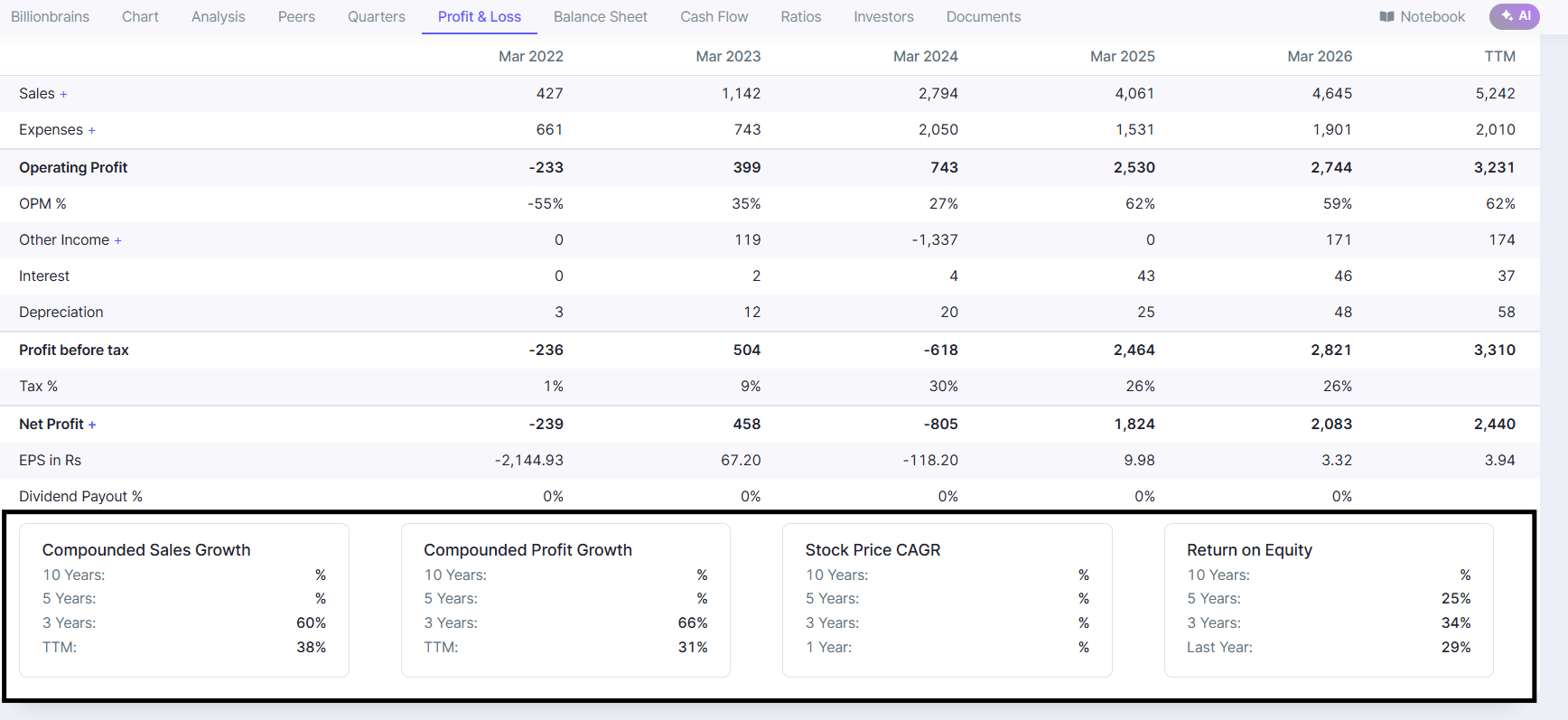
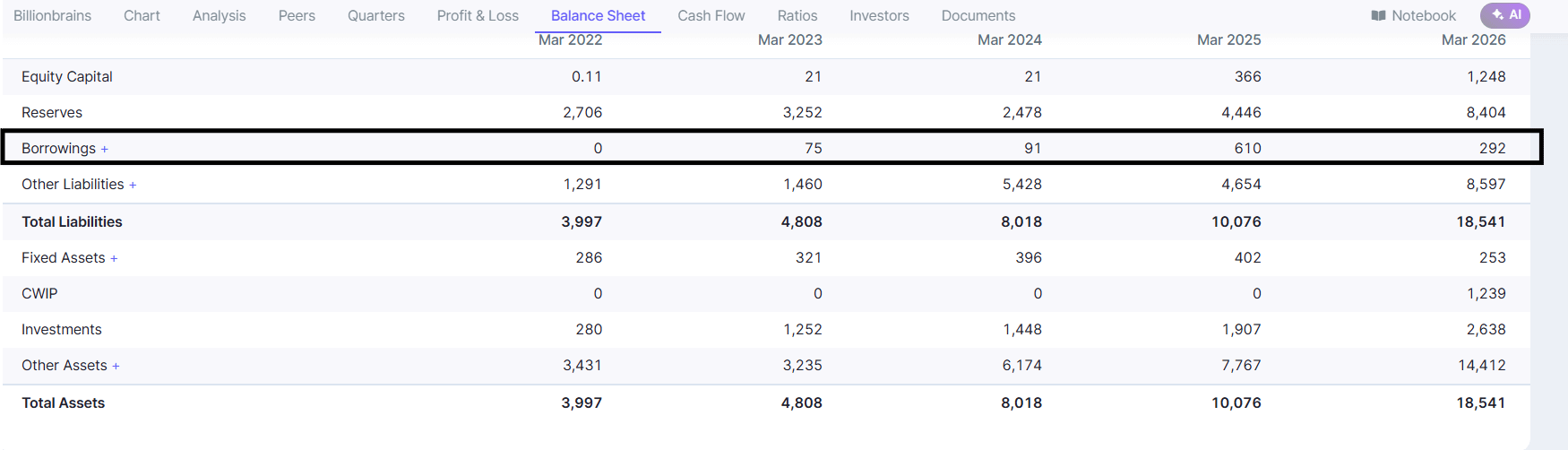
And that too with so little leverage on the books.
Growth is also a topic on which Paul Graham has written multiple times. But my favourite has been this part from the essay Want to Start a Startup?. He wrote it in September 2012.
“If you want to understand startups, understand growth. Growth drives everything in this world. Growth is why startups usually work on technology — because ideas for fast growing companies are so rare that the best way to find new ones is to discover those recently made viable by change, and technology is the best source of rapid change. Growth is why it’s a rational choice economically for so many founders to try starting a startup: growth makes the successful companies so valuable that the expected value is high even though the risk is too. Growth is why VCs want to invest in startups: not just because the returns are high but also because generating returns from capital gains is easier to manage than generating returns from dividends. Growth explains why the most successful startups take VC money even if they don’t need to: it lets them choose their growth rate. And growth explains why successful startups almost invariably get acquisition offers. To acquirers a fast-growing company is not merely valuable but dangerous too.”
While Paul Graham’s focus lies on the startup space, I take this learning into my microcap space. From that lens, I have tried to explain “Why” and “How” Groww, a megacap, is growing like a microcap. Nobody knows how long this growth will last for Groww. But my sense is something like this. As long as they keep doing what they have been doing in the past. As long as they keep growing as they have been growing in the past. I think the business will only become more and more valuable. I have no shame in admitting that as a public market investor I do not know today how to value it. Whether 50 times earnings is cheap or expensive is a very difficult question for me to answer. At least today. But you have to give it to them. It’s like a David and Goliath story. The interesting part is that David has now become Goliath in less than a decade. Can it retain its ability to look at emerging products and businesses as David and not Goliath? Time will tell.
Closing Thoughts
I cannot let you go without a movie connection. In one of my all time favourite hollywood movies, Forrest Gump, Tom Hanks, who plays Forrest’s character, says this at the end.
“I don’t know if Mama was right or if it’s Lieutenant Dan, I don’t know if we each have a destiny, or if we’re all just floating around accidentally-like on a breeze... but I think maybe it’s both. Maybe both are happening at the same time.”
As I look back at the growth story of Groww and the learnings from Paul Graham’s essays, I keep wondering. I don’t know if it was Paul Graham and YC who were instrumental in the growth of Groww, or if all good startups/microcaps turn out to be like Groww. I also think, maybe it’s both. Maybe both are happening at the same time.
Thanks for reading!
Disclosure: Not a customer of Groww. Not an investor in Groww. Not being compensated to write a blog on Groww. Just an arm-chair analyst admiring the business of Groww from a distance with all my limitations and biases.
P.S. Over the last few months, I was taking AI’s assistance in writing the blogs, but as this was a tribute to a master from his apprentice, I chose to write it 100% on my own. Hence, the delay of a day. From the usual Friday to Saturday this week. Apologies for the same.
 | A guest post by
|
I always wait for your articles , loved it!
Superb article, Ankit Sir...I am a big fan of your writing; the way you articulate things by linking to movies, articles, and books is top-notch