
L.T. Elevator- A Deep Dive
A microcap growing like a hormone-soused teenager ZN Research Lab #59


Yuval Noah Harai writes this in his famous book, Sapiens- A Brief History of Humankind:
“The modern economy has been growing like a hormone-soused teenager. It eats up everything it can find and puts on inches faster than you can count.”
There is a tiny SME/ microcap, L.T. Elevator, that is also exhibiting similar traits. But first the story behind how I discovered the business for this blog. I went through my recent blogs and noticed something strange. My last 5 blogs have been all new-age tech companies.
Either fintech or deep tech. But all five blogs were on tech companies. And my last blog was on Groww, which is a megacap. So, I was looking for something smaller and something that is old-economy. A smart investor called me last week. He called for some other reason. However, I have a strange, sometimes frustrating, habit of exchanging top 2-3 stock ideas whenever I meet anyone from the investing community. One of his favourite stocks turned out to be L.T. Elevator. And trust me, I am not making this up. My office building’s elevator has not been working for the last six weeks. It’s in HSR Layout in Bangalore. For the uninitiated, HSR is known to be a homeground for many unicorn SaaS-based startups. My monkey mind immediately jumped to an initial hypothesis that if I am facing this issue in a tier 1 city like Bangalore, the scope of improvement for this industry is huge.
So, with this initial framing, I started my research on the elevator industry. And my ignorance received a strong jolt soon. I was grossly mistaken to believe that the elevator industry does not require the latest technologies. In fact, the word technology itself is always understood in a very narrow sense. If I tell you just one word, technology, your mind will immediately think of softwares, computers, new-age platforms, etc. What if I told you that advanced technology plays a huge role in developing modern elevators. Not just that. Technology is also crucial to scale the business of elevators going forward.
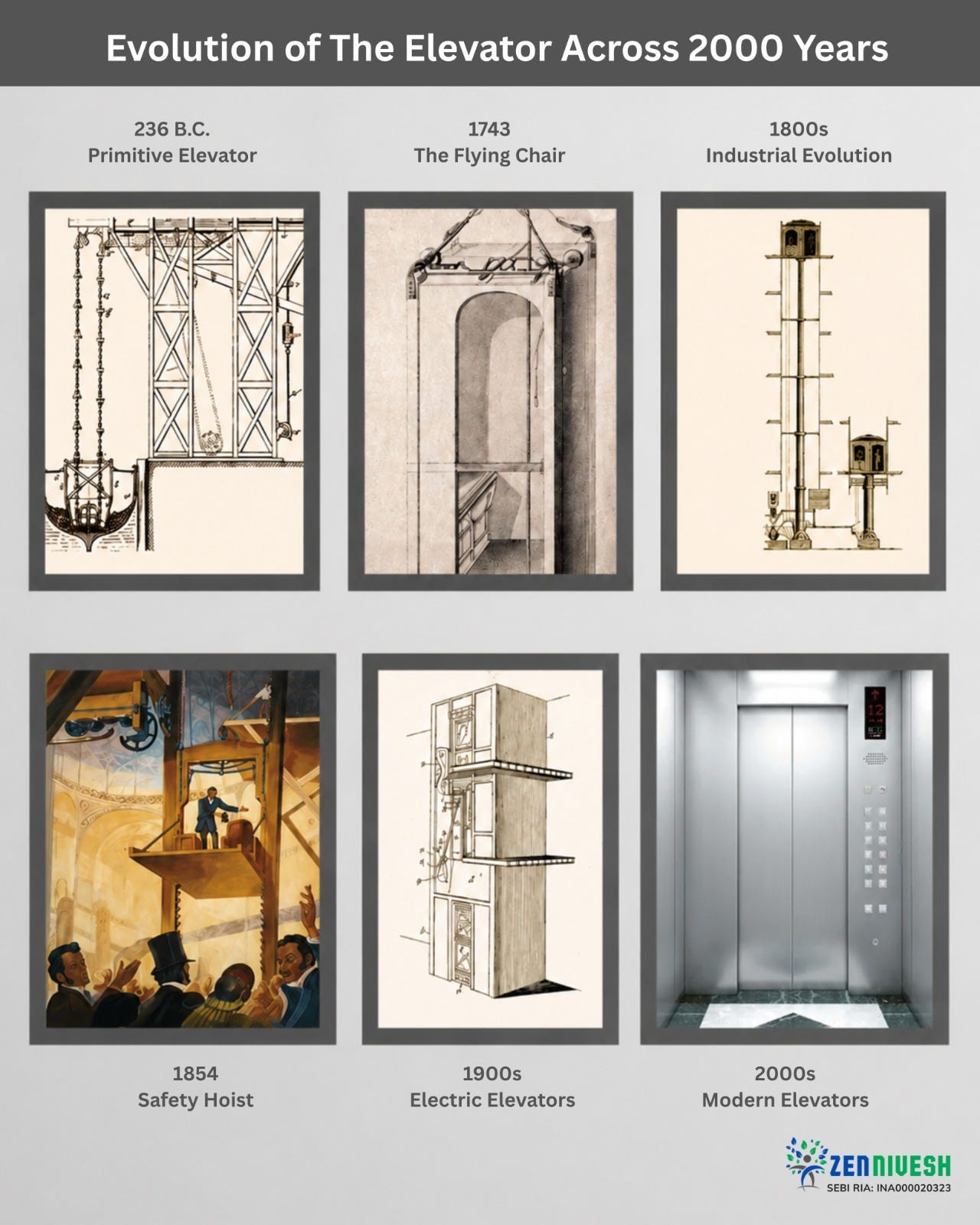
Let us quickly scan the 2000+ years of history and evolution of elevators. Yes. I am not exaggerating. In 236 BC, Archimedes, a famous Greek engineer and inventor, made a lift using a platform, ropes, a wheel, and the physical strength of a few people. In all probability, lifts were used even prior to that. However, Archimedes was the person to introduce and educate people about emerging technologies of that era. An efficient pulley system that was a giant leap for mankind in the evolution of lift. When you look back at the last 20 years, probably the technological advancements may not impress you. However, if you deep dive into the history of 2000 years you will appreciate the technological advancement this industry has gone through. We first learned to lift a platform. Then we learned to power it when electricity was invented. Then we made it more safe and prevented it from falling. Then we increased the speed so that we could travel safely and faster in multi-storied buildings. Then we learned to automate and coordinate thousands of other stuff. And finally, we learned how to overcome the constraints imposed by ropes, shafts, energy, and our own bodies. 2000+ years of history and evolution in one image below.
Now that I have put all my efforts to draw your attention to the elevator industry, it is time to introduce L.T. Elevator.
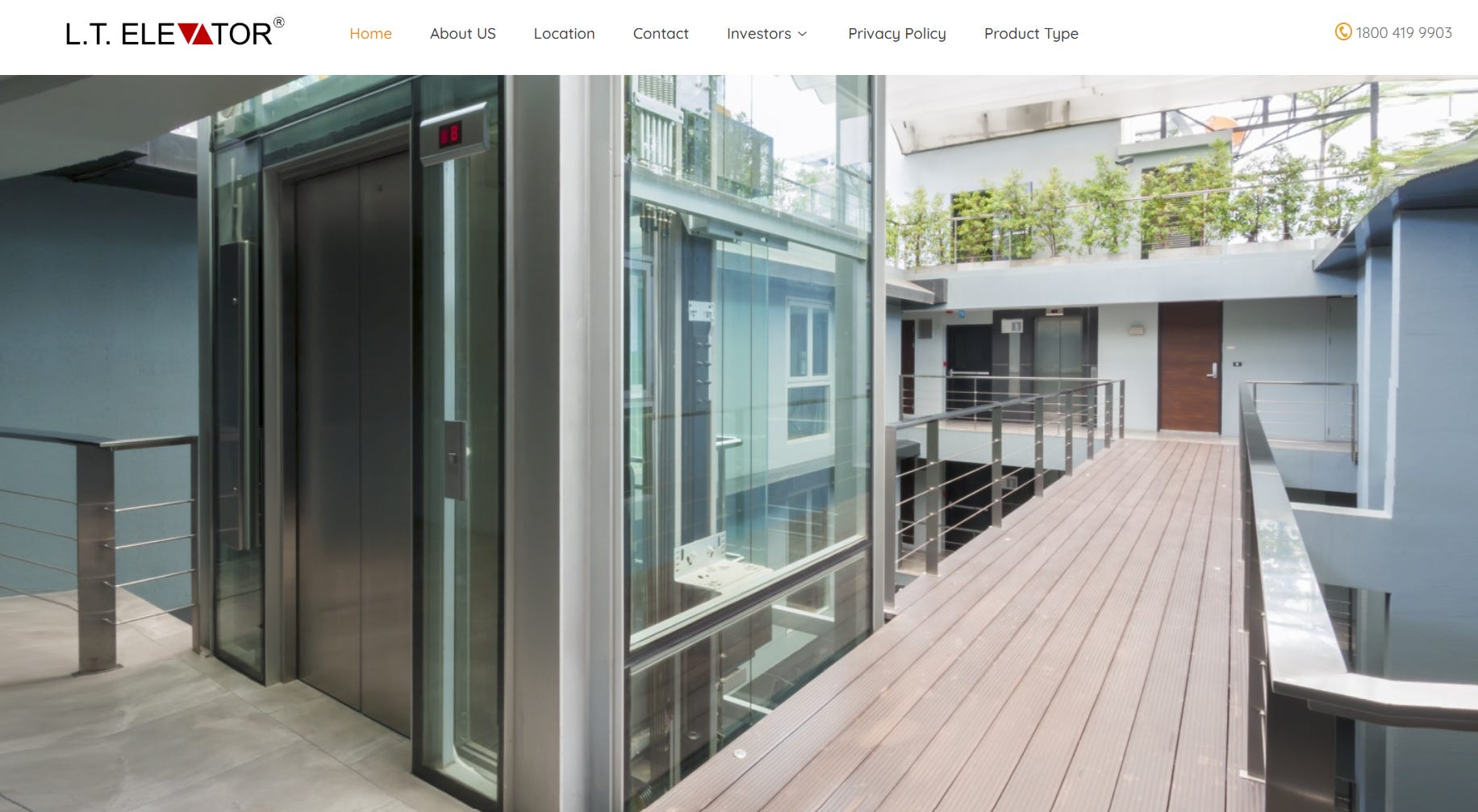
LT Elevator was incorporated on 27th August 2008 in Kolkata, West Bengal. It has been primarily a family-owned and family controlled business since inception.
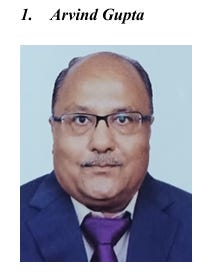

Mr. Arvind Gupta, aged 60 years, started the company. He has more than 38 years of experience in the vertical transportation system. Today, he is taking care of production and business development. Mr. Yash Gupta, aged 35 years, is the son of Mr. Arvind Gupta. He has a bachelors degree in Information technology and a post graduate diploma from Indian Institute of Management (IIM). Yash is the face since the IPO. Be it a pre-IPO meet or quarterly conference call or anything else. For a company of this small scale listed on the SME exchange, the transparency, clarity of thought, and detailing with which Mr Yash Gupta has answered all the analysts and investors questions made me notice two things clearly. The confidence in his ability and the solid grip on all the nuances of the business.
Global Elevator Industry
The global elevator industry may look boring and stagnant from the outside. But if you just scratch the surface a little bit, you will find something different. The global elevator market size was roughly estimated at USD 80 billion in 2024 and is anticipated to grow at a CAGR of 6.7% from 2025 to 2030. At a global scale, that is a pretty impressive growth. Just to put this into perspective. The global economy is growing roughly at 2% or may be slightly slower. So, this industry is slated to grow at thrice the speed of global economic growth. A few key drivers of this significant growth are rapid urbanization, sustained infrastructure development, and technological advancement. As cities expand, and population density goes up in urban areas, the demand for efficient vertical transport solutions in residential, commercial, and industrial buildings go up. Remember my office lift saga I shared at the start. A modern elevator of today is used for a variety of reasons you and I do not pay attention to. Movement of goods. Movement of people. Movement in ships. Movement in dams. Moreover, the rise of smart buildings and IoT and energy-efficient technologies is further propelling the market.
Global Smart Parking Industry
If I was surprised by the projected CAGR of the global elevator industry [6.7%], I was astounded when I looked at the same metric for the global smart parking industry. From a USD 6.49 billion market in 2022, it is expected to grow at a CAGR of 22% from 2023 to 2030. My source for these projected industry growth rates is the RHP filed by the company with SEBI. And as per the same, in India the growth rate of Smart Parking can be expected to be even higher than the global growth rate. Smart parking systems may directly find their place in the organized segments. But they also have a key role to play in the unorganized space too.
In the Indian elevator industry, at one end of the spectrum there are a lot of small marginal players, who do not have their in-house manufacturing. They are dependent on other players for manufacturing the elevator parts. These small marginal businesses assemble those parts in their facility. On an average they sell at max 40-50 elevators a year. There is a listed company, Aaron Industries, which caters to making these elevator cabins, elevator doors, and other elevator components. Aaron industries supplies it to both.
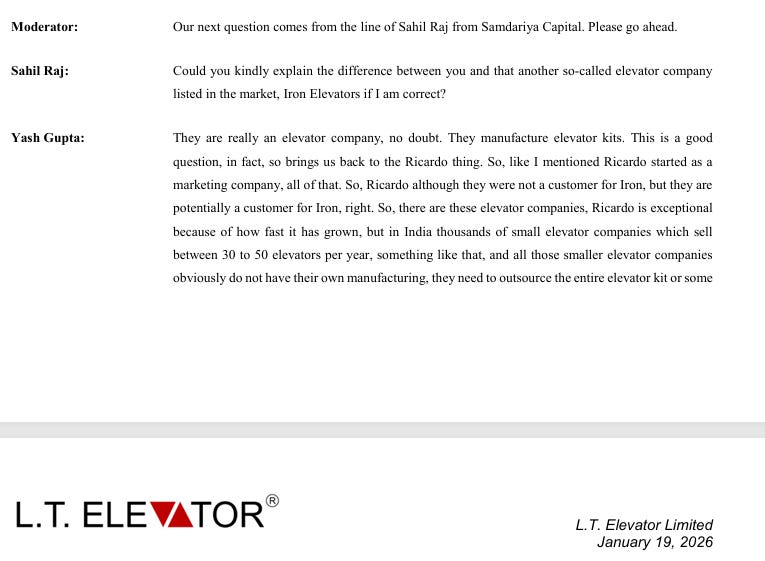
So, if the Indian economy grows, the residential, commercial and industrial real estate industry will be the main industry to witness growth. Elevator companies like L.T. Elevator is the ancillary. And I would call Aaron Industries an “Ancillary Ka Ancillary.” Now back to the elevator industry. On the other end of the spectrum, we have a Chennai-based Indian giant, Johnson Lifts, an Ahmedabad based, Omega Elevators, and a few MNC players like Kone, OTIS, Schindler, Mitsubishi, Hitachi, etc.
L.T. Elevator is right in the middle. It is neither small nor fragile like the marginal companies dependent on vendors for all the parts being manufactured. Also, it is not as large and rigid as the giants. Hence, it can be flexible and can keep re-inventing or adding new shapes and colours to its journey. I am reminded of what Robert Greene, a best-selling author of half a dozen good books says:
“We generally imagine that creative people have an interesting idea, which they then proceed to elaborate and refine in a somewhat linear process. The truth, however, is much messier and more complex. Creativity actually resembles a process known in nature as evolutionary hijacking. In evolution, accidents and contingencies play an enormous role. For instance, feathers evolved from reptilian scales, their purpose being to keep birds warm. (Birds evolved from reptiles.) But eventually, those existing feathers became adapted for the purpose of flying, transforming into wing feathers. For our own primate ancestors living in trees, the form of the hand largely evolved out of the need to grasp branches with speed and agility.”
Speed and Agility. Remember these two words. I will come back to them in a bit. But the larger point is that tiny microcaps like L.T. Elevators can afford to be creative and evolve faster through accidental events and contingencies than the giants. And unlike the boardroom driven mandates of MNCs, in a family-owned microcap like L.T. Elevator, an important business decision can be made in one dinner discussion between the father and the son. I can see that playing out beautifully in the evolution of L.T. Elevator in the lastone year, and especially after the IPO in September. Let me delve a little more on this creativity and evolution through accidental events and contingencies.
Prior to 2024, L.T. Elevator’s major right to win was the ability to provide end-to-end solutions in the elevator industry. It owns the whole value chain. It is one of the largest elevator manufacturers across the nation. With well established assembly lines, the company has an integrated production line, where 80% of its products are manufactured in house with the help of hi-tech German technology. They are India’s only indigenous elevator company with the latest modern German machinery and hi-tech infrastructure. They optimize and customize operations for maximum efficiency, immense product quality, improved customer experience, reduced risks and lower capital expenditure. Some of their prestigious clients and projects are mentioned in the image below.
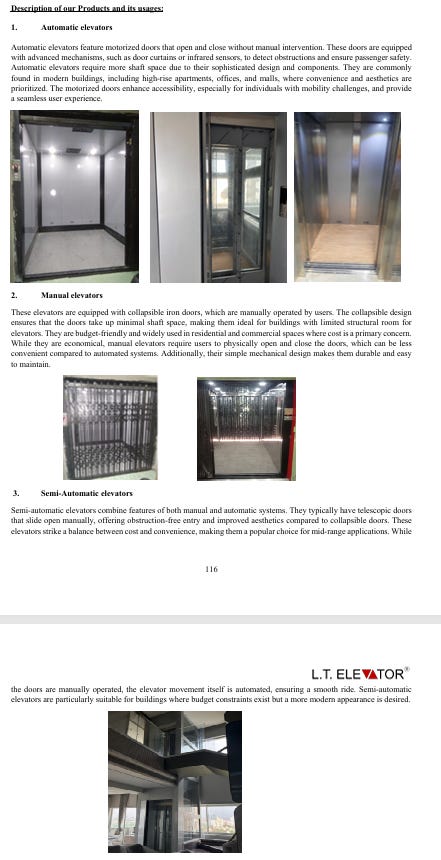
A glimpse of their products and usages can be found here.
But December 2024 was like an inflection point for their business. A “shot in the arm” kind of a moment. This is where I want you to recall the point of speed and agility I mentioned a while back. Since December 2024, one after another 4 key developments have put L.T. Elevator into a different orbit all together.
Event 1: 30th December, 2024
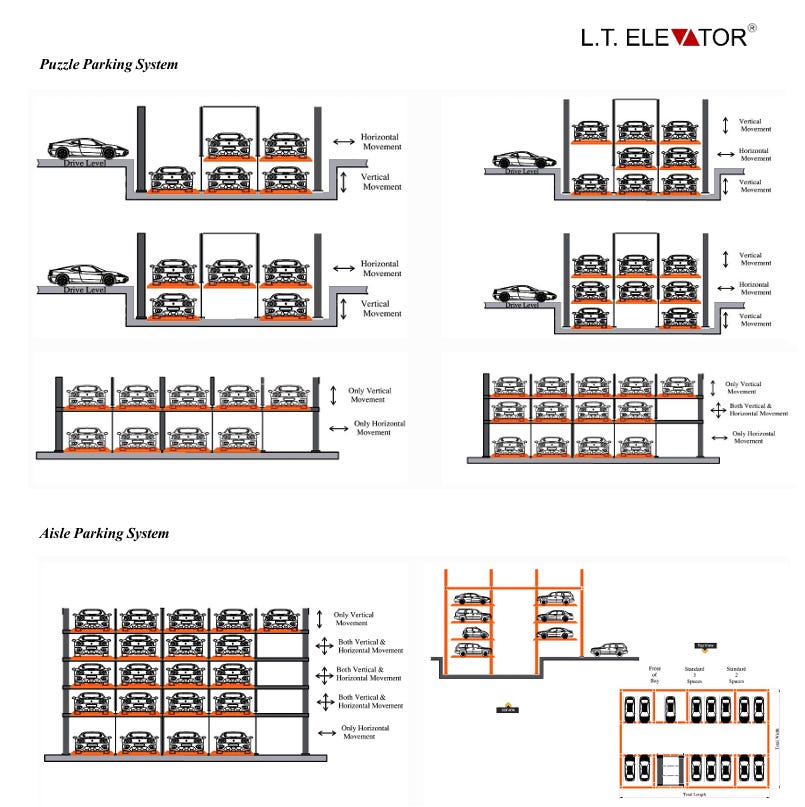
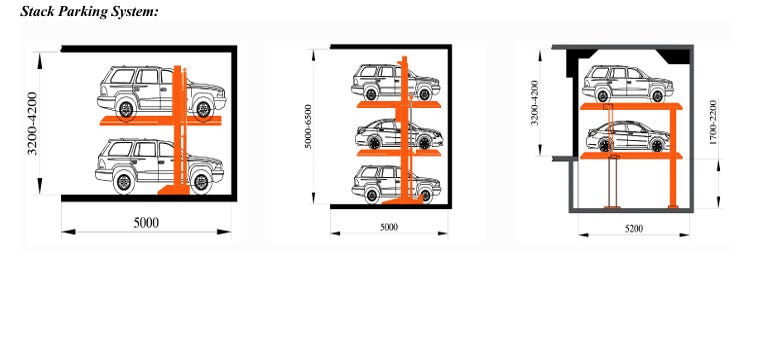
L.T. Elevator bought a 100% stake in Park Smart Solutions Limited on December 30, 2024. It is engaged in business of execution of turn-key Multi Level Car Parking Solutions including Design, Engineering, Supply, Installation & Commissioning (I&C) and Operation and
Maintenance of automatic Multi-level Car Parking System.
Now look at these numbers.
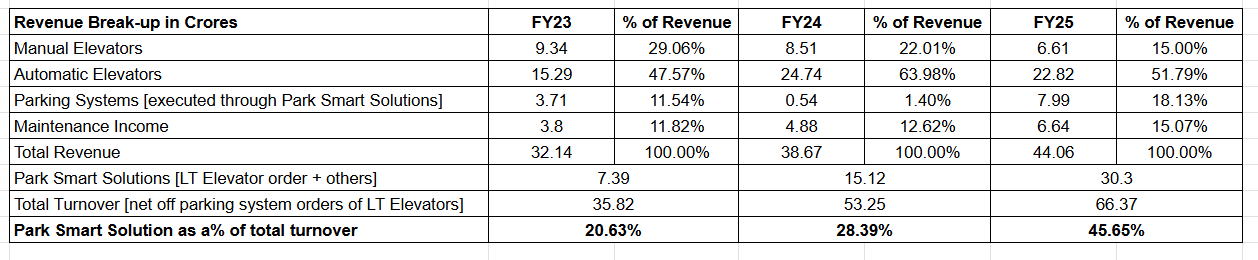
Two things here. First, L.T. Elevator acquired Park Smart Solutions in December 2024. Hence, do not think that L.T. Elevator had a total turnover of ₹36 Cr in FY23, ₹34 Cr in FY24 and ₹66 Cr in FY25. I have just added the numbers of all years to get a sense of how fast the parking system business is growing compared to the elevator business. Secondly, I could not find a granular break-up of FY26 numbers like the above. However, my sense is that the parking solution business in FY26 would have definitely crossed more than 50% of total turnover.
Event 2: 9th January 2026
L.T. Elevator acquires/merges Ricardo Elevators Private Limited.
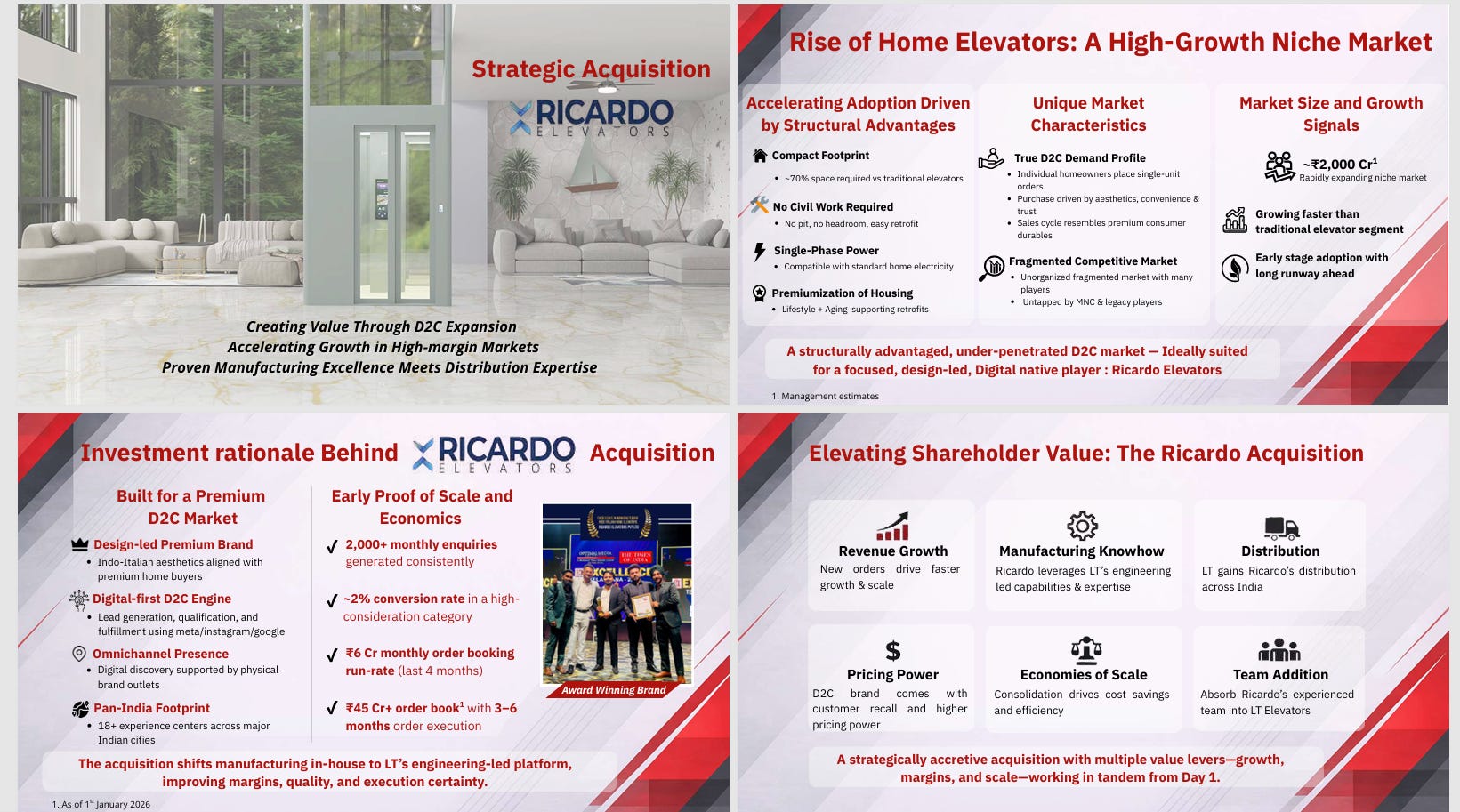
Ricardo Elevators operates in the fast-growing home-elevator segment, which serves individual homeowners seeking compact, customized lifts for two to four passengers. Unlike L.T. Elevator’s traditional B2B business, Ricardo follows a digital-first direct-to-consumer model, generating approximately 2,000–2,500 monthly enquiries, largely through Meta ads. Management sees the roughly ₹2,000 Cr home-elevator market as underpenetrated, with limited attention from large established competitors and significant potential for early-mover advantage. The acquisition is intended to develop Ricardo into a premium elevator brand that can eventually expand into other product categories. It is a strategic fit between Ricardo’s consumer-facing sales and marketing strengths and L.T. Elevator’s engineering, procurement, and in-house manufacturing capabilities.
If you read my last blog, you would be able to recall The Power of The Marginal and Do Things That Don’t Scale at once. And reconnect this with the business decisions made on the dinner table in a family-run business. Compare that to the long-drawn boardroom and brainstorming systems and processes in a large-sized company. Contrary to common beliefs, microcap businesses have a big advantage over the large megacap businesses. They can enter into tiny spaces that are small today, difficult to execute because of granularity, but growing very fast.
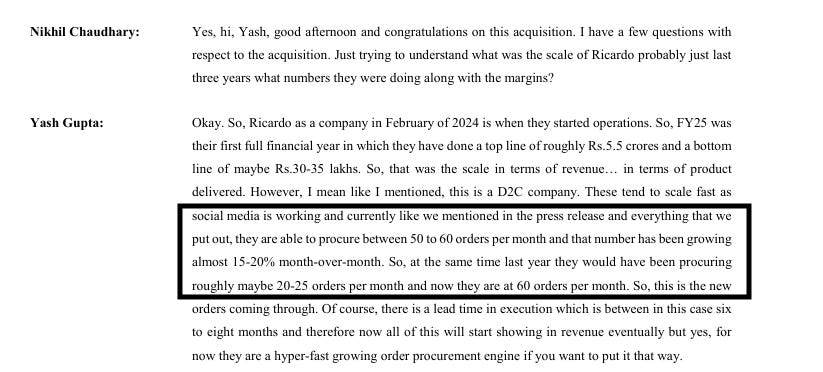
Does this D2C acquisition- a strong sales engine, ring a bell in your mind? In my mind, it surely does. I want to take you to the year 1957.
The legendary investor, Philip Fisher, wrote this in his famous book, Common Stocks & Uncommon Profits.
POINT 4. Does the company have an above-average sales organization?
In this competitive age, the products or services of few companies are so outstanding that they will sell to their maximum potentialities if they are not expertly merchandised. It is the making of a sale that is the most basic single activity of any business. Without sales, survival is impossible. It is the making of repeat sales to satisfied customers that is the first benchmark of success. Yet, strange as it seems, the relative efficiency of a company’s sales, advertising, and distributive organizations receives far less attention from most investors, even the careful ones, than do production, research, finance, or other major subdivisions of corporate activity.
There is probably a reason for this. It is relatively easy to construct simple mathematical ratios that will provide some sort of guide to the attractiveness of a company’s production costs, research activity, or financial structure in comparison with its competitors. It is a great deal harder to make ratios that have even a semblance of meaning in regard to sales and distribution efficiency. In regard to research we have already seen that such simple ratios are far too crude to provide anything but the first clues as to what to look for. Their value in relation to production and the financial structure will be discussed shortly. However, whether or not such ratios have anything like the value frequently placed upon them in financial circles, the fact remains that investors like to lean upon them. Because sales effort does not readily lend itself to this type of formulae, many investors fail to appraise it at all in spite of its basic importance in determining real investment worth.
Again, the way out of this dilemma lies in the use of the “scuttle-butt” technique. Of all the phases of a company’s activity, none is easier to learn about from sources outside the company than the relative efficiency of a sales organization. Both competitors and customers know the answers. Equally important, they are seldom hesitant to express their views. The time spent by the careful investor in inquiring into this subject is usually richly rewarded.
This timeless advice from Philip Fisher is often ignored by management and investors from time to time. But a few who pay attention reap all the benefits. I don’t know if the Gupta family of Kolkata knows about Philip Fisher. But they are surely following his advice anyway.
Event 3: 4th August 2026
L.T. Elevator signs a share purchase agreement to acquire DYPC Inc., South Korea. This marks their entry into global automated parking technology.
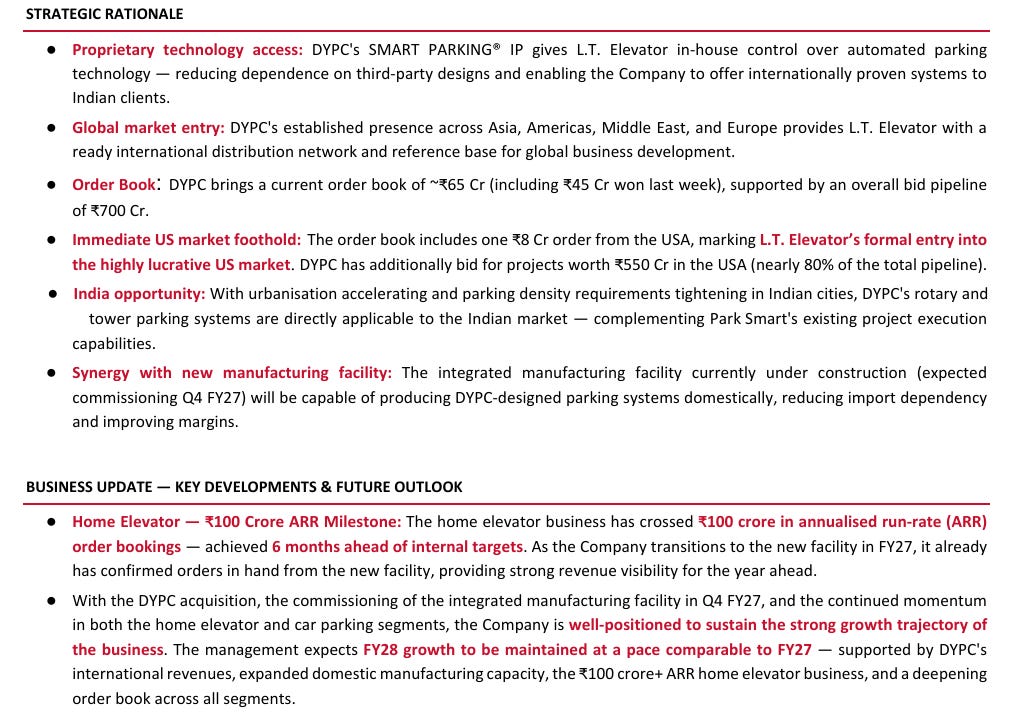
This is what the management says about the acquisition.
“The acquisition of DYPC is a defining moment for L.T. Elevator. We are not merely buying a company — we are acquiring technology, intellectual property, and a global footprint built over two decades. Combined with our integrated manufacturing facility coming online in Q4 FY27, our ₹100 crore ARR home elevator business, and the strong execution momentum in car parking, we believe L.T. Elevator is entering a new phase of growth that is structurally different from where we were even 12 months ago. FY27 and FY28 will reflect the full impact of these decisions.“ — Mr. Yash Gupta, Director, L.T. Elevator Limited
Now catch some breath and take a note of how fast and how far the company has travelled in such a short period of time. It’s like you are watching a 3-hour Christopher Nolan movie in a PVR IMAX theatre. You go out for just 10-15 minutes standing in the queue to get something to munch and drink. And you miss so many important parts of the story. The L.T. Elevator story is also progressing in that fashion.
Event 4: Two fundraise and 1 Acquisition through share-swap in 12 months
IPO happened in September 2025. Fund raised ₹40 Cr.
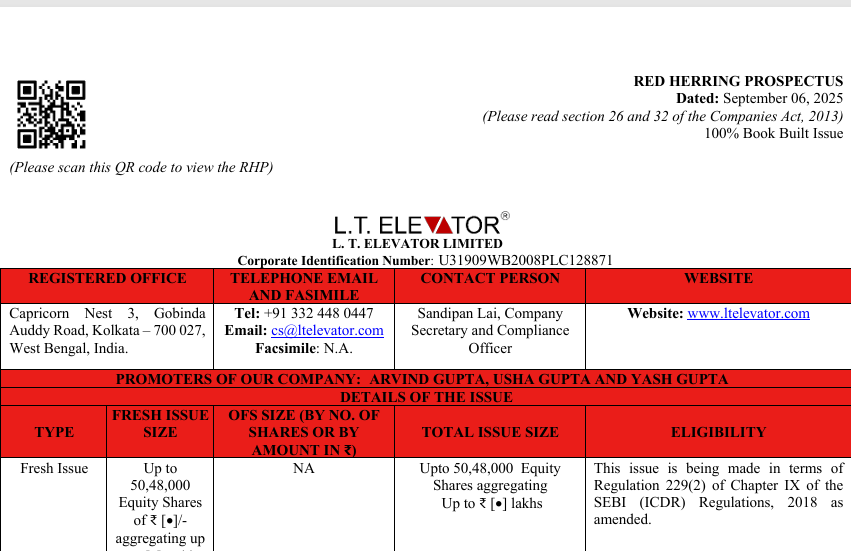
Ricardo Elevators acquired In January 2026. Paid through share swap post FY26.
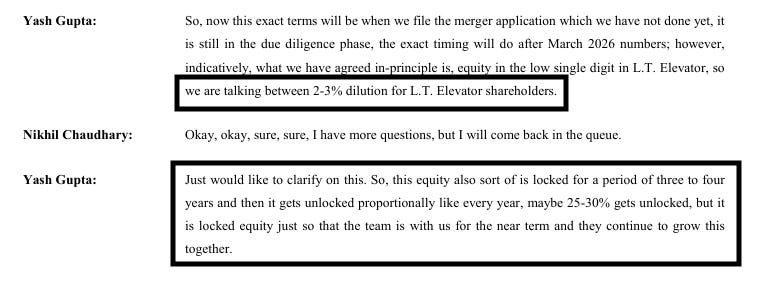
Preferential Allotment in June 2026.
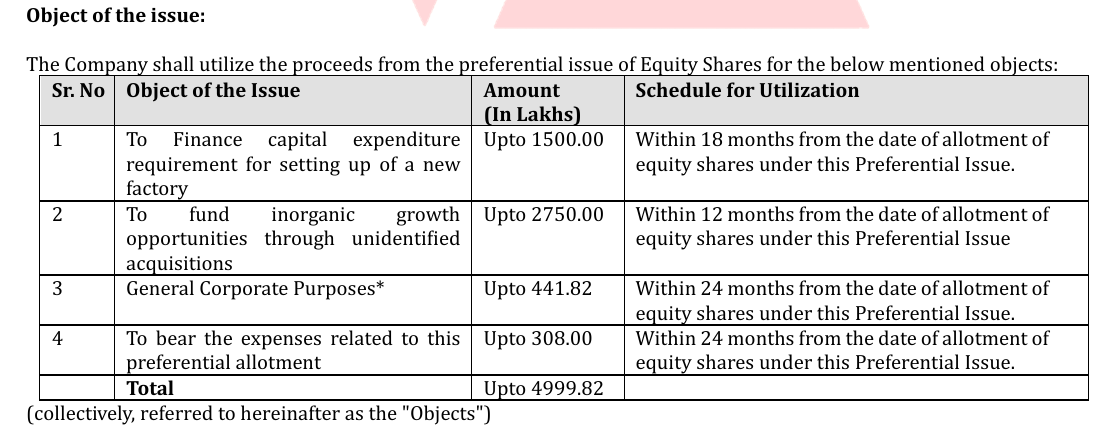
Now you understand why I gave this microcap the title of a hormone-soused teenager. Up until now, I have focused more on explaining the business, the growth strategies, and the speed and agility with which this business is expanding fast. Let me shift gears here.
Margin of Safety
In his famous book, The Intelligent investor, Benjamin Graham explains why margin of safety is needed.
“The function of the margin of safety is, in essence, that of rendering unnecessary an accurate estimate of the future. If the margin is a large one, then it is enough to assume that future earnings will not fall far below those of the past in order for an investor to feel sufficiently protected against the vicissitudes of time.”
However, understand that Graham was a pure statistical-bargain hunter. For him, the margin of safety could come only through price. If I only had to look at price or valuation, my job would be fairly simple. L.T. Elevator is growing its business at such a rapid pace with high margin [Gross margin 51%, EBITDA margin 24%, and Net Profit Margin 16%] and emerging capabilities, trading at 33 times trailing earnings and a reasonable chance of growing more than 100% in FY27 based on the last two acquisitions and the recent fund-raise. They have also embarked on a capex that is going to help them achieve scale in quick time.

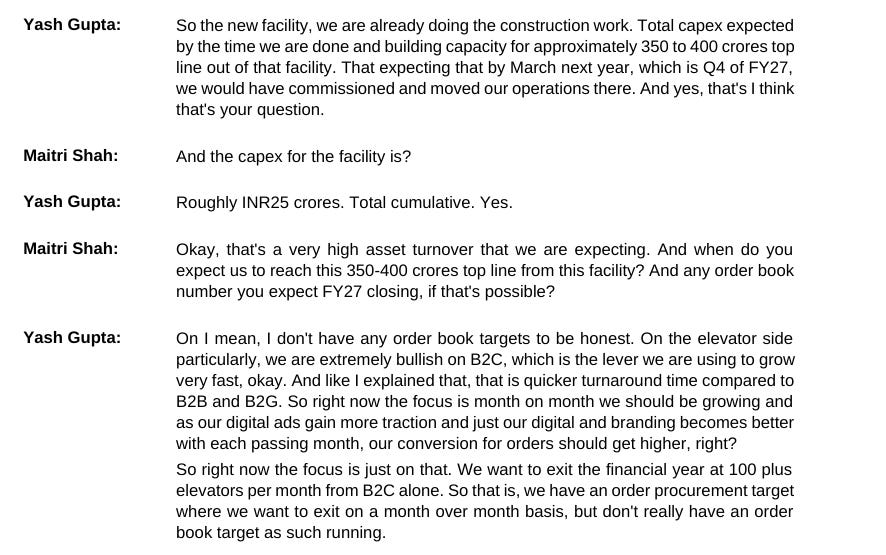
If you see the trajectory and quantum of growth in FY27 and FY28, the stock is trading fairly cheap even after the recent run-up in stock price post March 2026 slump.
The businesses around the world, global economy, and stock markets have evolved a great deal in the last century. I refrain from keeping only price as my margin of safety as Graham proposed in his book about seven and a half decades ago. For me, a few more things matter as much as the price I pay.
L.T. Elevator in the last 4 quarters have grown really fast. This is primarily on the back of the four events I have highlighted above. You may call me old school. But in my view, in none of the four events did L.T. Elevator go through any hiccup. So, they are not stress-tested in these four events yet. Everything has gone smoothly. And everything is changing so fast. At least for my comfort.
From primarily a B2B player, they expanded the B2G business in the last 2 years and are now going the B2C route aggressively. It is excruciatingly difficult to understand how the margins and working capital situation will evolve in the next few quarters or years. While the management seems to be aggressive and prudent at the same time, I cannot be oblivious to the uncertainties and risks that arise due to these rapidly developing moving parts of the system.
I would like to introduce a little bit of mathematics and statistics here. Let’s assume, going forward, in all the four events individually, there is just a 10% chance of a bottleneck or a challenge. Now, let’s try to find out the probability of no problems at all.
P(no problems)=(1−0.10)^4 = 0.9^4 =0.6561
So the probability of no problems is 65.61%. Which means there is a 35% chance of a problem.
I am not playing a spoilsport here. I wish them well and probably no obstacle will come in their journey ahead. However, they are the men in the arena and I am an arm-chair analyst cum investor. I can’t think and act like them.
Closing Thoughts
If you wish to understand a potential microcap opportunity that is growing very fast, you must come back to this timeless and thoughtful remark of Paul Graham.
“If you want to understand startups, understand growth. Growth drives everything in this world. Growth is why startups usually work on technology — because ideas for fast growing companies are so rare that the best way to find new ones is to discover those recently made viable by change, and technology is the best source of rapid change. Growth is why it’s a rational choice economically for so many founders to try starting a startup: growth makes the successful companies so valuable that the expected value is high even though the risk is too. Growth is why VCs want to invest in startups: not just because the returns are high but also because generating returns from capital gains is easier to manage than generating returns from dividends. Growth explains why the most successful startups take VC money even if they don’t need to: it lets them choose their growth rate. And growth explains why successful startups almost invariably get acquisition offers. To acquirers a fast-growing company is not merely valuable but dangerous too.”
Paul Graham may have written about growth for startups. I refuse to believe that the same principle doesn’t work for a fast-growing SME or microcap business. And L.T. Elevator surely is one of them that stands out. You may like them, hate them, but cannot ignore them.
Thanks for reading!
SEBI RIA Disclosure: No Holding, No Recommendation
P.S. Know more about Zen Nivesh and our origin story here.
 | A guest post by
|
Amazing write up, forget the company, the write up is more zingy & edge of the seat reading ...Just like the company ...kudos...(try writing a book too on any subject...your writing skills are mind blowing & should not just be limited to analysis for companies)
Thoroughly enjoyed reading and very jealous of your writing ability Ankit ji.
More power to you!